









LIBRO INGLESE





The Loss of Sadness

54,30 €
+540
punti 

Venditore: Feltrinelli
Articolo acquistabile con Carta del Docente

Articolo acquistabile con Carta Cultura Giovani e Carta del Merito

Paga con Klarna in 3 rate senza interessi per ordini superiori a 39 €

Dati e Statistiche
 Salvato in 1 lista dei desideri
Salvato in 1 lista dei desideri
The Loss of Sadness
Disponibilità in 2 settimane
54,30 €
54,30 €
Disp. in 2 settimane
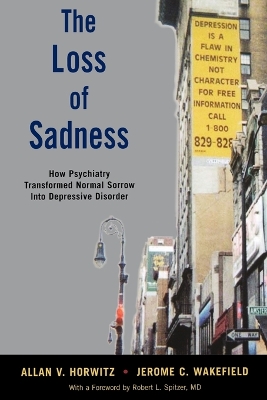



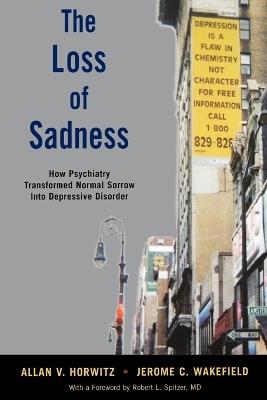
Depression has become the single most commonly treated mental disorder, amid claims that one out of ten Americans suffer from this disorder every year and 25% succumb at some point in their lives. Warnings that depressive disorder is a leading cause of worldwide disability have been accompanied by a massive upsurge in the consumption of antidepressant medication, widespread screening for depression in clinics and schools, and a push to diagnose depression early, on the basis of just a few symptoms, in order to prevent more severe conditions from developing. In The Loss of Sadness, Allan V. Horwitz and Jerome C. Wakefield argue that, while depressive disorder certainly exists and can be a devastating condition warranting medical attention, the apparent epidemic in fact reflects the way the psychiatric profession has understood and reclassified normal human sadness as largely an abnormal experience. With the 1980 publication of the landmark third edition of the Diagnostic and Statistical Manual of Mental Disorders (DSM-III), mental health professionals began diagnosing depression based on symptoms-such as depressed mood, loss of appetite, and fatigue-that lasted for at least two weeks. This system is fundamentally flawed, the authors maintain, because it fails to take into account the context in which the symptoms occur. They stress the importance of distinguishing between abnormal reactions due to internal dysfunction and normal sadness brought on by external circumstances. Under the current DSM classification system, however, this distinction is impossible to make, so the expected emotional distress caused by upsetting events-for example, the loss of a job or the end of a relationship-could lead to a mistaken diagnosis of depressive disorder. Indeed, it is this very mistake that lies at the root of the presumed epidemic of major depression in our midst. In telling the story behind this phenomenon, the authors draw on the 2,500-year history of writing about depression, including studies in both the medical and social sciences, to demonstrate why the DSM's diagnosis is so flawed. They also explore why it has achieved almost unshakable currency despite its limitations. Framed within an evolutionary account of human health and disease, The Loss of Sadness presents a fascinating dissection of depression as both a normal and disordered human emotion and a sweeping critique of current psychiatric diagnostic practices. The result is a potent challenge to the diagnostic revolution that began almost thirty years ago in psychiatry and a provocative analysis of one of the most significant mental health issues today.
-
Autore:
-
Editore:
-
Anno:2012
-
Rilegatura:Paperback / softback
-
Pagine:304 p.
Testo in English
Dimensioni:
234 x 159 mm
Peso:
440 gr.
EAN:
9780199921577
Informazioni e Contatti sulla Sicurezza dei Prodotti
Le schede prodotto sono aggiornate in conformità al Regolamento UE 988/2023. Laddove ci fossero taluni dati non disponibili per ragioni indipendenti da Feltrinelli, vi informiamo che stiamo compiendo ogni ragionevole sforzo per inserirli. Vi invitiamo a controllare periodicamente il sito www.lafeltrinelli.it per eventuali novità e aggiornamenti.
Per le vendite di prodotti da terze parti, ciascun venditore si assume la piena e diretta responsabilità per la commercializzazione del prodotto e per la sua conformità al Regolamento UE 988/2023, nonché alle normative nazionali ed europee vigenti.
Per informazioni sulla sicurezza dei prodotti, contattare productsafety@feltrinelli.it
