










LIBRO INGLESE





Anthropic Bias: Observation Selection Effects in Science and Philosophy


85,60 €
+860
punti 
Venditore: Feltrinelli
Articolo acquistabile con Carta del Docente

Articolo acquistabile con Carta Cultura Giovani e Carta del Merito

Articolo acquistabile con Carta della Cultura

Paga con Klarna in 3 rate senza interessi per ordini superiori a 39 €

Dati e Statistiche
 Salvato in 1 lista dei desideri
Salvato in 1 lista dei desideri
Anthropic Bias: Observation Selection Effects in Science and Philosophy
Disponibilità in 2 settimane
85,60 €
85,60 €
Disponibilità in 2 settimane

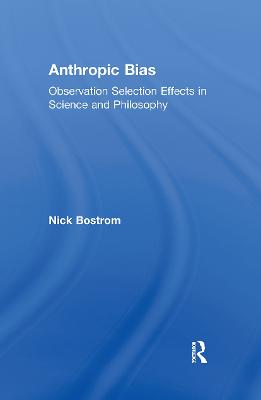



Anthropic Bias explores how to reason when you suspect that your evidence is biased by "observation selection effects"--that is, evidence that has been filtered by the precondition that there be some suitably positioned observer to "have" the evidence. This conundrum--sometimes alluded to as "the anthropic principle," "self-locating belief," or "indexical information"--turns out to be a surprisingly perplexing and intellectually stimulating challenge, one abounding with important implications for many areas in science and philosophy. There are the philosophical thought experiments and paradoxes: the Doomsday Argument; Sleeping Beauty; the Presumptuous Philosopher; Adam & Eve; the Absent-Minded Driver; the Shooting Room. And there are the applications in contemporary science: cosmology ("How many universes are there?", "Why does the universe appear fine-tuned for life?"); evolutionary theory ("How improbable was the evolution of intelligent life on our planet?"); the problem of time's arrow ("Can it be given a thermodynamic explanation?"); quantum physics ("How can the many-worlds theory be tested?"); game-theory problems with imperfect recall ("How to model them?"); even traffic analysis ("Why is the 'next lane' faster?"). Anthropic Bias argues that the same principles are at work across all these domains. And it offers a synthesis: a mathematically explicit theory of observation selection effects that attempts to meet scientific needs while steering clear of philosophical paradox.
-
Autore:
-
Editore:
-
Collana:Studies in Philosophy
-
Anno:2010
-
Rilegatura:Paperback / softback
-
Pagine:230 p.
Testo in English
Dimensioni:
229 x 152 mm
Peso:
440 gr.
EAN:
9780415883948


Informazioni e Contatti sulla Sicurezza dei Prodotti
Le schede prodotto sono aggiornate in conformità al Regolamento UE 988/2023. Laddove ci fossero taluni dati non disponibili per ragioni indipendenti da Feltrinelli, vi informiamo che stiamo compiendo ogni ragionevole sforzo per inserirli. Vi invitiamo a controllare periodicamente il sito www.lafeltrinelli.it per eventuali novità e aggiornamenti.
Per le vendite di prodotti da terze parti, ciascun venditore si assume la piena e diretta responsabilità per la commercializzazione del prodotto e per la sua conformità al Regolamento UE 988/2023, nonché alle normative nazionali ed europee vigenti.
Per informazioni sulla sicurezza dei prodotti, contattare productsafety@feltrinelli.it
