









LIBRO INGLESE





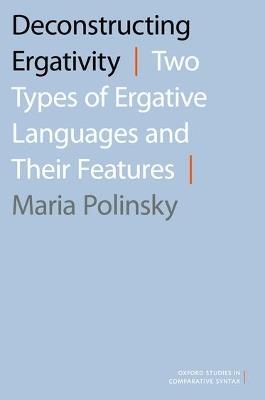
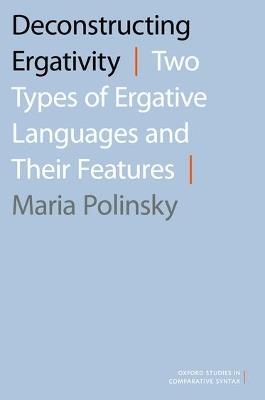
Deconstructing Ergativity: Two Types of Ergative Languages and Their Features

76,30 €
+760
punti 
Venditore: Feltrinelli
Articolo acquistabile con Carta del Docente

Articolo acquistabile con Carta Cultura Giovani e Carta del Merito

Articolo acquistabile con Carta della Cultura

Paga con Klarna in 3 rate senza interessi per ordini superiori a 39 €

Dati e Statistiche
 Salvato in 0 liste dei desideri
Salvato in 0 liste dei desideri
Deconstructing Ergativity: Two Types of Ergative Languages and Their Features
Disponibilità in 2 settimane
76,30 €
76,30 €
Disponibilità in 2 settimane



Nominative-accusative and ergative are two common alignment types found across languages. In the former type, the subject of an intransitive verb and the subject of a transitive verb are expressed the same way, and differently from the object of a transitive. In ergative languages, the subject of an intransitive and the object of a transitive appear in the same form, the absolutive, and the transitive subject has a special, ergative, form. Ergative languages often follow very different patterns, thus evading a uniform description and analysis. A simple explanation for that has to do with the idea that ergative languages, much as their nominative-accusative counterparts, do not form a uniform class. In this book, Maria Polinsky argues that ergative languages instantiate two main types, the one where the ergative subject is a prepositional phrase (PP-ergatives) and the one with a noun-phrase ergative. Each type is internally consistent and is characterized by a set of well-defined properties. The book begins with an analysis of syntactic ergativity, which as Polinsky argues, is a manifestation of the PP-ergative type. Polinsky discusses diagnostic properties that define PPs in general and then goes to show that a subset of ergative expressions fit the profile of PPs. Several alternative analyses have been proposed to account for syntactic ergativity; the book presents and outlines these analyses and offers further considerations in support of the PP-ergativity approach. The book then discusses the second type, DP-ergative languages, and traces the diachronic connection between the two types. The book includes two chapters illustrating paradigm PP-ergative and DP-ergative languages: Tongan and Tsez. The data used in these descriptions come from Polinsky's original fieldwork hence presenting new empirical facts from both languages.
-
Autore:
-
Editore:
-
Collana:Oxford Studies in Comparative Syntax
-
Anno:2016
-
Rilegatura:Paperback / softback
-
Pagine:410 p.
Testo in English
Dimensioni:
234 x 155 mm
Peso:
544 gr.
EAN:
9780190256593

Informazioni e Contatti sulla Sicurezza dei Prodotti
Le schede prodotto sono aggiornate in conformità al Regolamento UE 988/2023. Laddove ci fossero taluni dati non disponibili per ragioni indipendenti da Feltrinelli, vi informiamo che stiamo compiendo ogni ragionevole sforzo per inserirli. Vi invitiamo a controllare periodicamente il sito www.lafeltrinelli.it per eventuali novità e aggiornamenti.
Per le vendite di prodotti da terze parti, ciascun venditore si assume la piena e diretta responsabilità per la commercializzazione del prodotto e per la sua conformità al Regolamento UE 988/2023, nonché alle normative nazionali ed europee vigenti.
Per informazioni sulla sicurezza dei prodotti, contattare productsafety@feltrinelli.it
