










LIBRO INGLESE





Designing Self-Healing Systems with .NET: From Resilience to Autonomous Recovery in Modern Software Systems


60,49 €
+600
punti 
Venditore: Feltrinelli
Articolo acquistabile con Carta del Docente

Articolo acquistabile con Carta Cultura Giovani e Carta del Merito

Articolo acquistabile con Carta della Cultura

Paga con Klarna in 3 rate senza interessi per ordini superiori a 39 €

Dati e Statistiche
 Salvato in 0 liste dei desideri
Salvato in 0 liste dei desideri
Designing Self-Healing Systems with .NET: From Resilience to Autonomous Recovery in Modern Software Systems
Disponibilità in 3 settimane
60,49 €
60,49 €
Disponibilità in 3 settimane
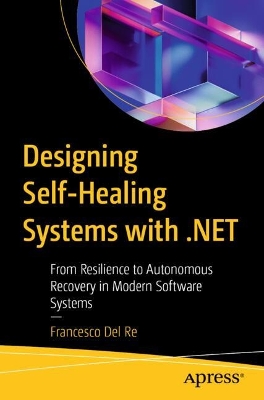



Software systems fail. The expensive part is not the failure itself but the recovery: manual restarts, replayed jobs, drained queues, and configuration changes performed under pressure at inconvenient hours. Most teams already know the corrective actions for their common incidents. What they lack is an architecture that can apply those actions without waiting for a human to intervene every time. This book brings recovery into the architecture. It treats self-healing as a design discipline and provides a reference architecture that organizes detection, decision, safety, execution, and verification into a coherent control loop. It then delivers a concrete reference implementation in .NET, mapping every architectural layer to explicit contracts and components that teams can study, adapt, and extend. The architecture is grounded in production experience on a large distributed platform that connected dozens of public administrations through document exchange flows. As external integrations multiplied, each new dependency brought failure modes that demanded their own detection logic and recovery strategies. The design described in these pages emerged from that growth, and the anecdotes, case studies, and decisions throughout the text reflect that origin. The treatment goes beyond cloud-native microservices. It covers monoliths, legacy systems, hybrid environments, batch processing, messaging, and queue-centered workloads. It addresses the operating model as well: governance, safety boundaries, adoption roadmap, anti-patterns, and organizational roles. No existing title combines a self-healing reference architecture with a .NET reference implementation, and I believe this book addresses a gap that practicing .NET architects will recognize. What You Will Learn: Design and implement a self-healing reference architecture in .NET, with explicit contracts for observation, detection, decision, safety, execution, and verification. Classify failure modes (stall, degradation, traffic absence, gray failure) and build composite detection rules that reduce false positives while catching real conditions. Design bounded recovery actions (restart, degraded mode, quarantine, replay, credential rotation) with safety guards, cooldowns, action budgets, and verification gates. Apply self-healing patterns across different deployment topologies: single deployable, API-worker pair, queue-centered tier, modular monolith, distributed services, and hybrid/legacy environments. Build the organizational operating model behind self-healing: governance, adoption roadmap, maturity assessment, incident integration, and team roles. Who This Book is For The primary audience is .NET software architects and senior developers who design and operate backend systems, distributed services, messaging platforms, and integration layers. These professionals deal with production reliability challenges and are looking for a structured approach to automated recovery beyond ad-hoc retry logic and restart scripts.
-
Autore:
-
Editore:
-
Anno:2026
-
Rilegatura:Paperback / softback
Testo in English
Dimensioni:
235 x 155 mm
EAN:
9798868831768

Informazioni e Contatti sulla Sicurezza dei Prodotti
Le schede prodotto sono aggiornate in conformità al Regolamento UE 988/2023. Laddove ci fossero taluni dati non disponibili per ragioni indipendenti da Feltrinelli, vi informiamo che stiamo compiendo ogni ragionevole sforzo per inserirli. Vi invitiamo a controllare periodicamente il sito www.lafeltrinelli.it per eventuali novità e aggiornamenti.
Per le vendite di prodotti da terze parti, ciascun venditore si assume la piena e diretta responsabilità per la commercializzazione del prodotto e per la sua conformità al Regolamento UE 988/2023, nonché alle normative nazionali ed europee vigenti.
Per informazioni sulla sicurezza dei prodotti, contattare productsafety@feltrinelli.it
