









EBOOK IN LINGUA STRANIERA





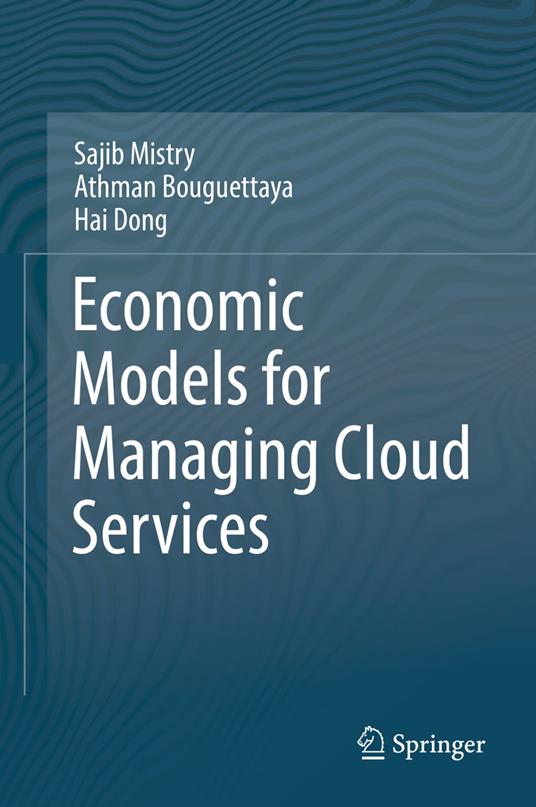
Economic Models for Managing Cloud Services

46,79 €
+470
punti 
Venditore: Feltrinelli

Acquista online
Scaricabile subito
Articolo acquistabile con Carta del Docente

Articolo acquistabile con Carta Cultura Giovani e Carta del Merito

Articolo acquistabile con Carta della Cultura

Dati e Statistiche
 Salvato in 0 liste dei desideri
Salvato in 0 liste dei desideri
Economic Models for Managing Cloud Services
Scaricabile subito
46,79 €
46,79 €
Scaricabile subito



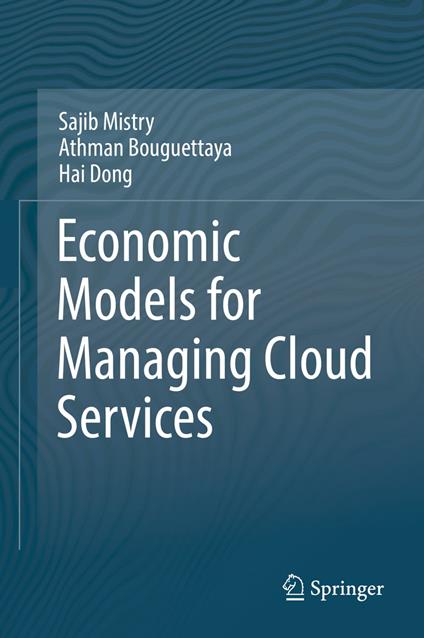
The authors introduce both the quantitative and qualitative economic models as optimization tools for the selection of long-term cloud service requests. The economic models fit almost intuitively in the way business is usually done and maximize the profit of a cloud provider for a long-term period. The authors propose a new multivariate Hidden Markov and Autoregressive Integrated Moving Average (HMM-ARIMA) model to predict various patterns of runtime resource utilization. A heuristic-based Integer Linear Programming (ILP) optimization approach is developed to maximize the runtime resource utilization. It deploys a Dynamic Bayesian Network (DBN) to model the dynamic pricing and long-term operating cost. A new Hybrid Adaptive Genetic Algorithm (HAGA) is proposed that optimizes a non-linear profit function periodically to address the stochastic arrival of requests. Next, the authors explore the Temporal Conditional Preference Network (TempCP-Net) as the qualitative economic model to represent the high-level IaaS business strategies. The temporal qualitative preferences are indexed in a multidimensional k-d tree to efficiently compute the preference ranking at runtime. A three-dimensional Q-learning approach is developed to find an optimal qualitative composition using statistical analysis on historical request patterns. Finally, the authors propose a new multivariate approach to predict future Quality of Service (QoS) performances of peer service providers to efficiently configure a TempCP-Net. It discusses the experimental results and evaluates the efficiency of the proposed composition framework using Google Cluster data, real-world QoS data, and synthetic data. It also explores the significance of the proposed approach in creating an economically viable and stable cloud market. This book can be utilized as a useful reference to anyone who is interested in theory, practice, and application of economic models in cloud computing. This book will be an invaluable guide for small and medium entrepreneurs who have invested or plan to invest in cloud infrastructures and services. Overall, this book is suitable for a wide audience that includes students, researchers, and practitioners studying or working in service-oriented computing and cloud computing.
-
Autore:
-
Anno edizione:2018
-
Editore:
-
Formato:
-
Lingua:Inglese
Compatibilità:
Tutti i dispositivi (eccetto Kindle) Scopri di più
Layout:
Reflowable
EAN:
9783319738765

Formato:
Gli eBook venduti da Feltrinelli.it sono in formato ePub e possono essere protetti da Adobe DRM. In caso di download di un file protetto da DRM si otterrà un file in formato .acs, (Adobe Content Server Message), che dovrà essere aperto tramite Adobe Digital Editions e autorizzato tramite un account Adobe, prima di poter essere letto su pc o trasferito su dispositivi compatibili.
Cloud:
Gli eBook venduti da Feltrinelli.it sono sincronizzati automaticamente su tutti i client di lettura Kobo successivamente all’acquisto. Grazie al Cloud Kobo i progressi di lettura, le note, le evidenziazioni vengono salvati e sincronizzati automaticamente su tutti i dispositivi e le APP di lettura Kobo utilizzati per la lettura.
Clicca qui per sapere come scaricare gli ebook utilizzando un pc con sistema operativo Windows
