


EBOOK IN LINGUA STRANIERA


EPUB Parsing & Rendering Engine

16,99 €
+170
punti 
Venditore: Feltrinelli

Acquista online
Scaricabile subito
Articolo acquistabile con Carta del Docente

Articolo acquistabile con Carta Cultura Giovani e Carta del Merito

Articolo acquistabile con Carta della Cultura

Dati e Statistiche
 Salvato in 0 liste dei desideri
EPUB Parsing & Rendering Engine
Scaricabile subito
16,99 €
16,99 €
Scaricabile subito
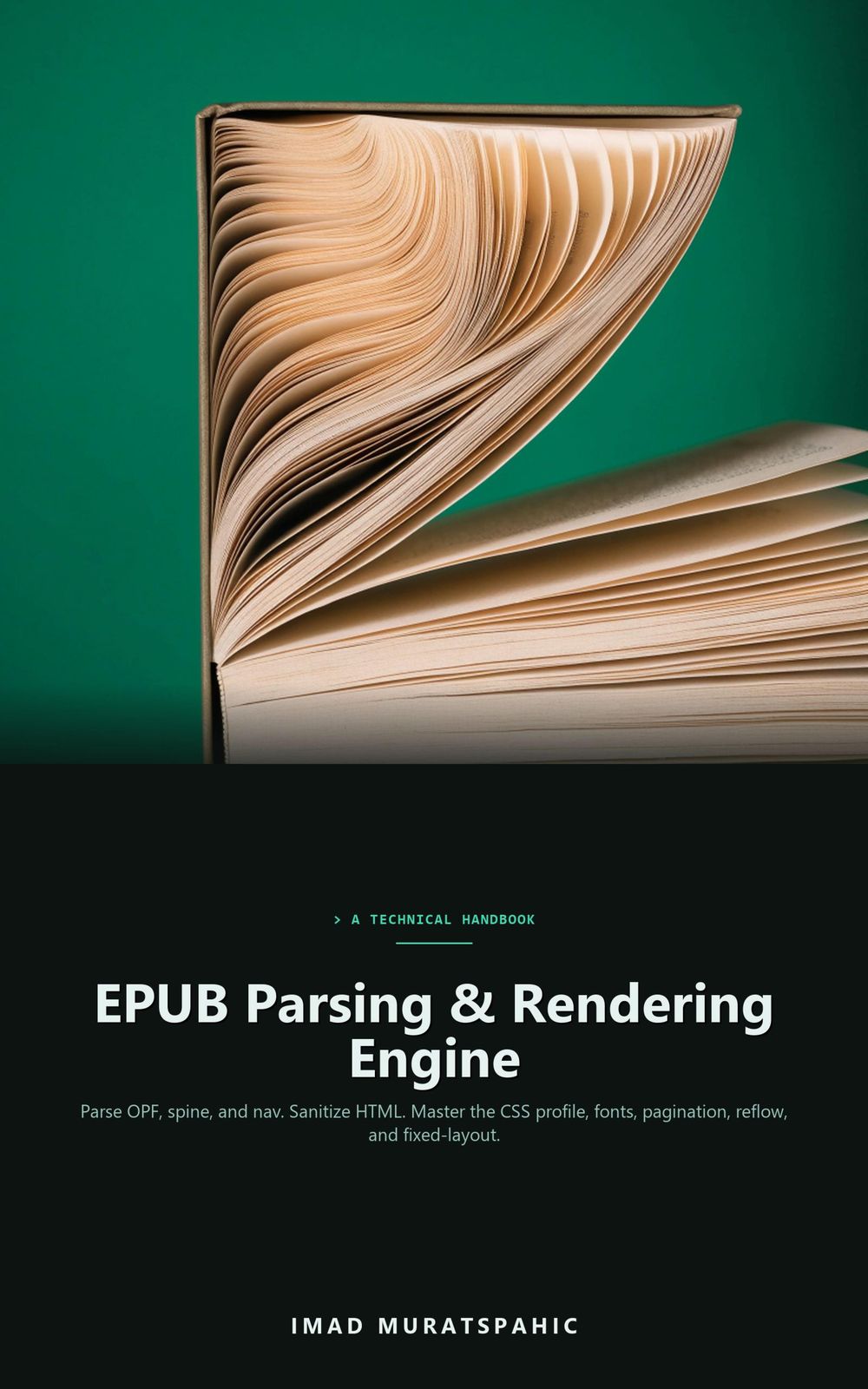


Every e-reader, library app, and conversion pipeline has to answer the same question: given a.epub file from anywhere, how do you turn it into pages a person can actually read? This handbook answers it end to end, from the first byte of the ZIP container to a working reference engine you can run yourself. You'll open the container correctly — and see exactly how a miscompressed mimetype file breaks readers silently — parse the OPF package document's metadata, manifest, and spine, and build a unified table of contents from both the EPUB 3 navigation document and its EPUB 2 NCX predecessor. From there, the book treats every content document as what it actually is in the wild: untrusted HTML that has to be sanitized against script injection, tracking beacons, and path-traversal attacks before it's safe to render. The second half covers what most tutorials skip. The EPUB CSS profile, and how the cascade really resolves across reading-system, author, and user stylesheets. The exact IDPF font-obfuscation algorithm, byte-for-byte, so embedded fonts stop failing with no explanation. Pagination for reflowable text and the EPUB CFI addressing scheme that keeps a reader's place through a font-size change. Fixed-layout rendition, synthetic spreads, and the accessibility gap fixed layout introduces. Validation against EPUBCheck, and the performance discipline a library of a few thousand books actually demands. Every technique is demonstrated in real, runnable Python, including a compact reference engine in the closing chapter that ties the whole pipeline together — tested against this book's own EPUB file. Written for engineers building a reading app, a documentation viewer, a conversion tool, or QA tooling around the EPUB format, not for casual readers wondering how their e-reader works.
-
Autore:
-
Anno edizione:2026
-
Editore:
-
Formato:
-
Lingua:Tedesco
Compatibilità:
Tutti i dispositivi (eccetto Kindle) Scopri di più
Layout:
Reflowable
EAN:
9783565997930

Formato:
Gli eBook venduti da Feltrinelli.it sono in formato ePub e possono essere protetti da Adobe DRM. In caso di download di un file protetto da DRM si otterrà un file in formato .acs, (Adobe Content Server Message), che dovrà essere aperto tramite Adobe Digital Editions e autorizzato tramite un account Adobe, prima di poter essere letto su pc o trasferito su dispositivi compatibili.
Cloud:
Gli eBook venduti da Feltrinelli.it sono sincronizzati automaticamente su tutti i client di lettura Kobo successivamente all’acquisto. Grazie al Cloud Kobo i progressi di lettura, le note, le evidenziazioni vengono salvati e sincronizzati automaticamente su tutti i dispositivi e le APP di lettura Kobo utilizzati per la lettura.
Clicca qui per sapere come scaricare gli ebook utilizzando un pc con sistema operativo Windows
