










LIBRO INGLESE





Input-Output Models for Sustainable Industrial Systems: Implementation Using LINGO

132,00 €
+1320
punti 
Venditore: Feltrinelli
Articolo acquistabile con Carta del Docente

Articolo acquistabile con Carta Cultura Giovani e Carta del Merito

Articolo acquistabile con Carta della Cultura

Paga con Klarna in 3 rate senza interessi per ordini superiori a 39 €

Dati e Statistiche
 Salvato in 0 liste dei desideri
Salvato in 0 liste dei desideri
Input-Output Models for Sustainable Industrial Systems: Implementation Using LINGO
Disponibilità in 2 settimane
132,00 €
132,00 €
Disponibilità in 2 settimane

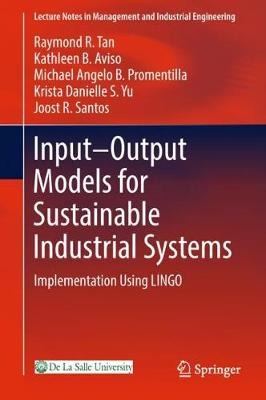



This book addresses the specialized topic of input–output models for sustainable industrial systems. While these models are well-established tools for economic analysis, their underlying mathematical structure is also applicable to the analysis and optimization of a wide range of systems that are characterized by linear interdependencies among their components. This means that input–output models can be used for diverse networks, such as processes within industrial plants, industrial plants in a supply chain, or departmental units within an organization. The models can also be readily extended to interactions between man-made systems and the environment, e.g. flows of natural resources and/or pollutants. Furthermore, model variants with excess degrees of freedom can be formulated to allow optimization and decision-making to be integrated within the framework. This book examines how input–output models can be applied to sustainable industrial systems. Each major variant is discussed separately in a dedicated chapter, and representative case studies and supporting LINGO code are also included.
-
Autore:
-
Editore:
-
Collana:Lecture Notes in Management and Industrial Engineering
-
Anno:2018
-
Rilegatura:Hardback
Pagine:
151 p.
Testo in English
Dimensioni:
235 x 155 mm
EAN:
9789811318726

Informazioni e Contatti sulla Sicurezza dei Prodotti
Le schede prodotto sono aggiornate in conformità al Regolamento UE 988/2023. Laddove ci fossero taluni dati non disponibili per ragioni indipendenti da Feltrinelli, vi informiamo che stiamo compiendo ogni ragionevole sforzo per inserirli. Vi invitiamo a controllare periodicamente il sito www.lafeltrinelli.it per eventuali novità e aggiornamenti.
Per le vendite di prodotti da terze parti, ciascun venditore si assume la piena e diretta responsabilità per la commercializzazione del prodotto e per la sua conformità al Regolamento UE 988/2023, nonché alle normative nazionali ed europee vigenti.
Per informazioni sulla sicurezza dei prodotti, contattare productsafety@feltrinelli.it
