









EBOOK IN LINGUA STRANIERA





Spatial and Material Forces in Nonlinear Continuum Mechanics

149,75 €
+1500
punti 
Venditore: Feltrinelli

Acquista online
Scaricabile subito
Articolo acquistabile con Carta del Docente

Articolo acquistabile con Carta Cultura Giovani e Carta del Merito

Articolo acquistabile con Carta della Cultura

Dati e Statistiche
 Salvato in 0 liste dei desideri
Salvato in 0 liste dei desideri
Spatial and Material Forces in Nonlinear Continuum Mechanics
Scaricabile subito
149,75 €
149,75 €
Scaricabile subito
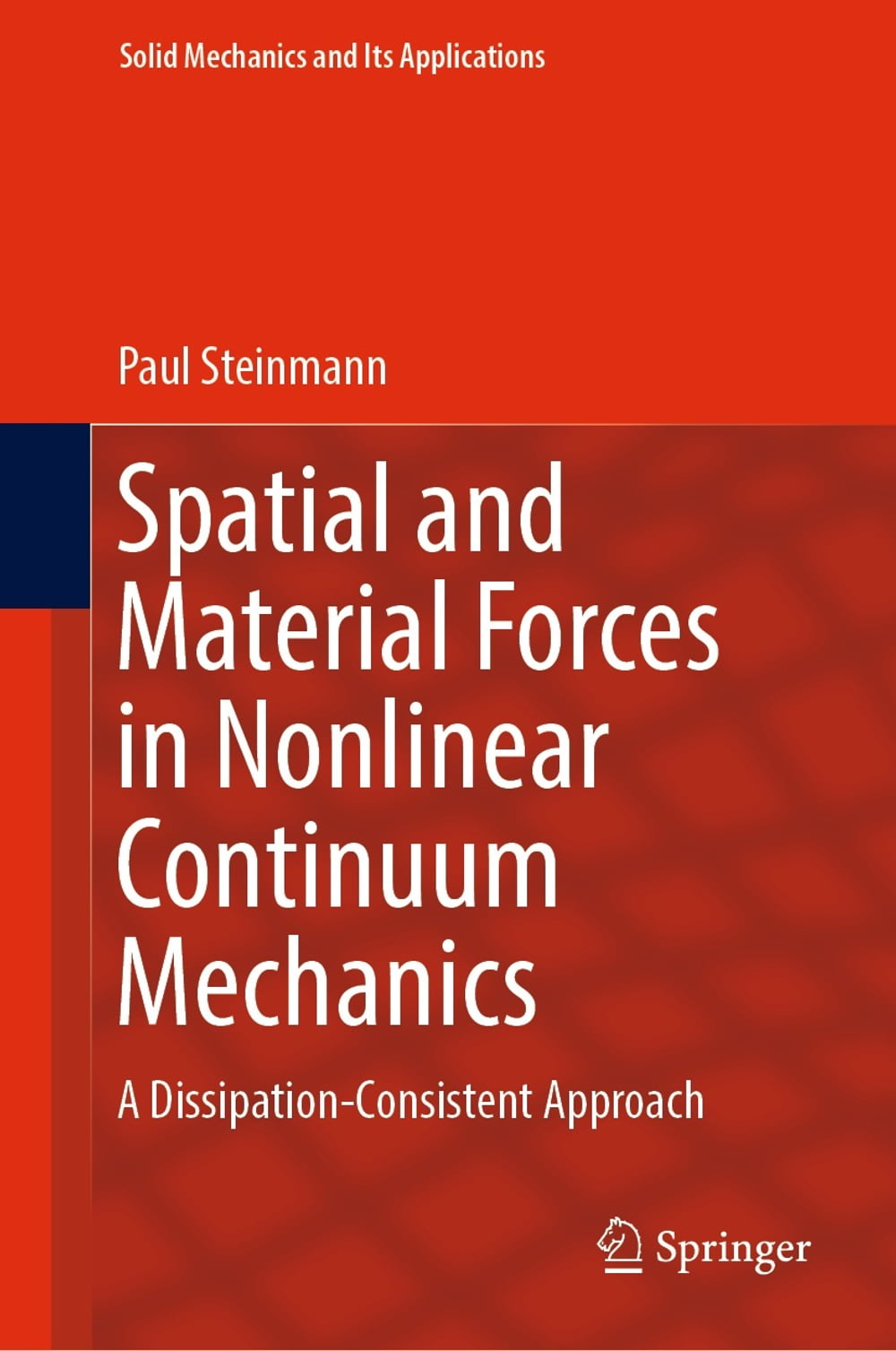


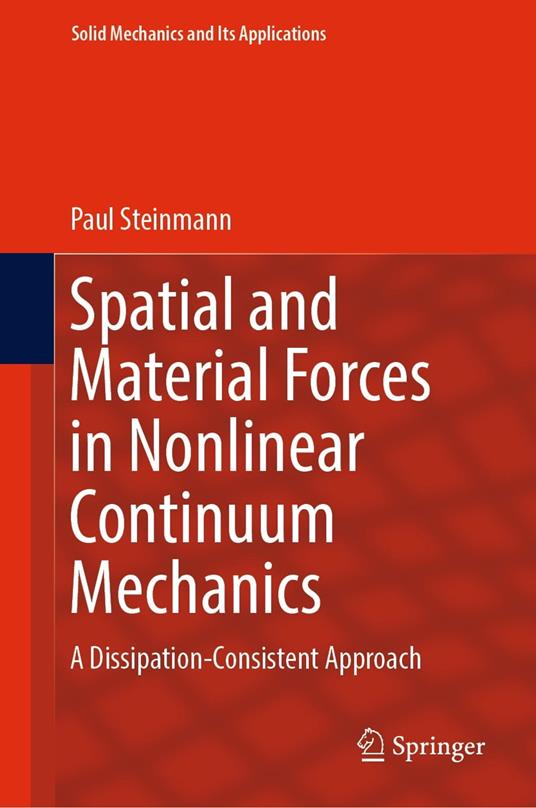
This monograph details spatial and material vistas on non-linear continuum mechanics in a dissipation-consistent approach. Thereby, the spatial vista renders the common approach to nonlinear continuum mechanics and corresponding spatial forces, whereas the material vista elaborates on configurational mechanics and corresponding material or rather configurational forces. Fundamental to configurational mechanics is the concept of force. In analytical mechanics, force is a derived object that is power conjugate to changes of generalised coordinates. For a continuum body, these are typically the spatial positions of its continuum points. However, if in agreement with the second law, continuum points, e.g. on the boundary, may also change their material positions. Configurational forces are then power conjugate to these configurational changes. A paradigm is a crack tip, i.e. a singular part of the boundary changing its position during crack propagation, with the relatedconfigurational force, typically the J-integral, driving its evolution, thereby consuming power, typically expressed as the energy release rate. Taken together, configurational mechanics is an unconventional branch of continuum physics rationalising and unifying the tendency of a continuum body to change its material configuration. It is thus the ideal formulation to tackle sophisticated problems in continuum defect mechanics. Configurational mechanics is entirely free of restrictions regarding geometrical and constitutive nonlinearities and offers an accompanying versatile computational approach to continuum defect mechanics. In this monograph, I present a detailed summary account of my approach towards configurational mechanics, thereby fostering my view that configurational forces are indeed dissipation-consistent to configurational changes.
-
Autore:
-
Anno edizione:2022
-
Editore:
-
Formato:
-
Lingua:Inglese
Compatibilità:
Tutti i dispositivi (eccetto Kindle) Scopri di più
Layout:
Reflowable
EAN:
9783030890704

Formato:
Gli eBook venduti da Feltrinelli.it sono in formato ePub e possono essere protetti da Adobe DRM. In caso di download di un file protetto da DRM si otterrà un file in formato .acs, (Adobe Content Server Message), che dovrà essere aperto tramite Adobe Digital Editions e autorizzato tramite un account Adobe, prima di poter essere letto su pc o trasferito su dispositivi compatibili.
Cloud:
Gli eBook venduti da Feltrinelli.it sono sincronizzati automaticamente su tutti i client di lettura Kobo successivamente all’acquisto. Grazie al Cloud Kobo i progressi di lettura, le note, le evidenziazioni vengono salvati e sincronizzati automaticamente su tutti i dispositivi e le APP di lettura Kobo utilizzati per la lettura.
Clicca qui per sapere come scaricare gli ebook utilizzando un pc con sistema operativo Windows
