










EBOOK IN LINGUA STRANIERA





Too Much to Know: The One Brain Barrier

3,49 €
+30
punti 
Venditore: Feltrinelli

Acquista online
Scaricabile subito
Articolo acquistabile con Carta del Docente

Articolo acquistabile con Carta Cultura Giovani e Carta del Merito

Articolo acquistabile con Carta della Cultura

Abbonati a Kobo plus per avere accesso illimitato a questo contenuto

Dati e Statistiche
 Salvato in 0 liste dei desideri
Salvato in 0 liste dei desideri
Too Much to Know: The One Brain Barrier
Scaricabile subito
3,49 €
3,49 €
Scaricabile subito

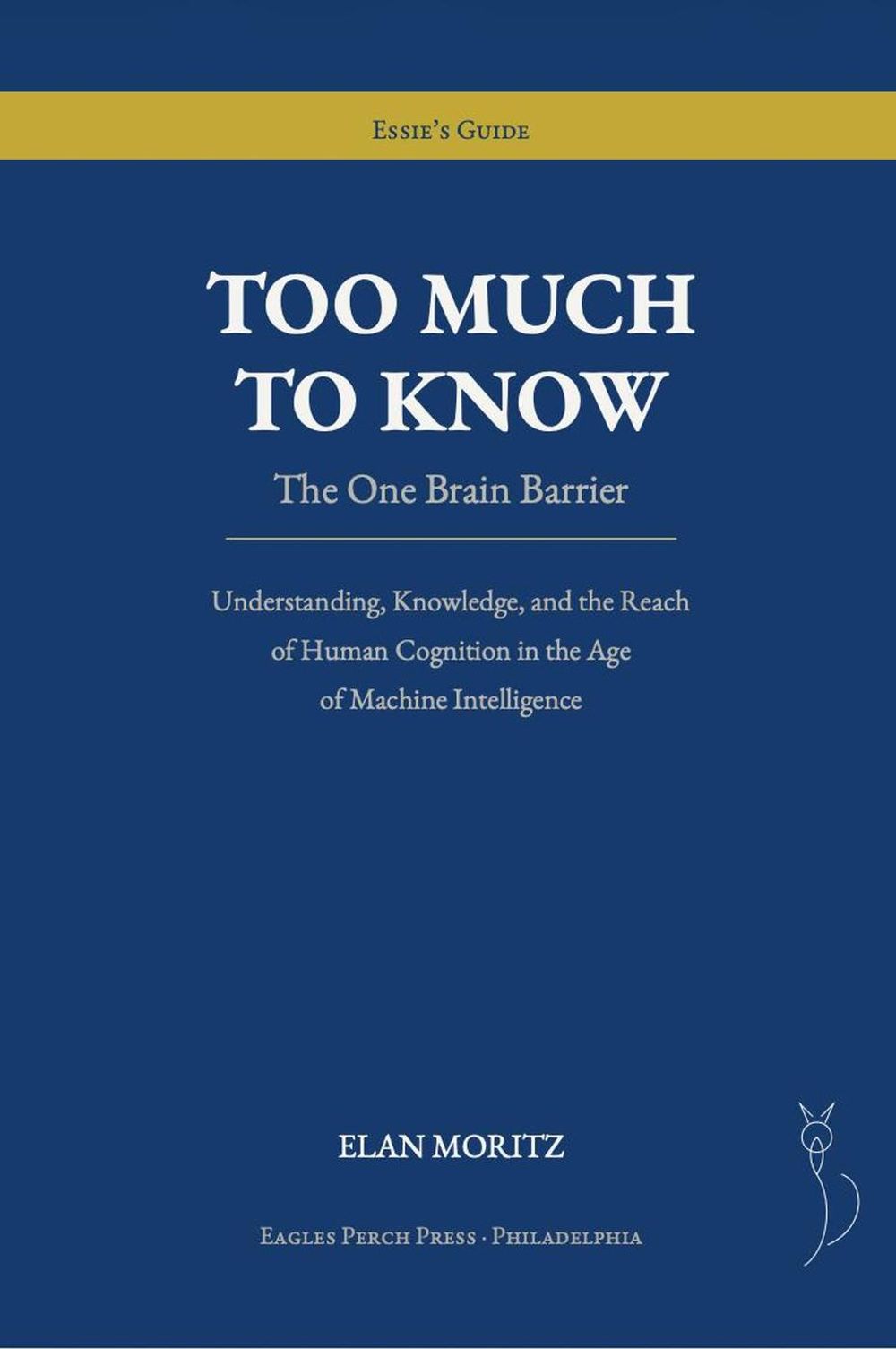


Every mind has a ceiling. Knowledge does not. What happens at that boundary? Every generation has assumed it stood at the edge of knowable things. Every generation has been wrong — not because knowledge ran out, but because it kept growing, outpacing any individual mind's capacity to follow it. Elan Moritz calls this the one brain barrier (obb): the irreducible cognitive ceiling that every human being, however gifted, carries through life. Too Much to Know: The One Brain Barrier is a work of intellectual nonfiction that takes this ceiling seriously. Drawing on cognitive science, epistemology, the history of ideas, and the contemporary explosion of machine intelligence, Moritz argues that the obb is among the most consequential — and most overlooked — facts about the human condition. It shapes how science advances and stalls, how institutions manage and lose knowledge, how education transmits understanding across generations, and how individuals navigate a world whose complexity long ago outgrew any single perspective. The book opens with a framework of cosmic emergence — seven transitions from nothingness to power over the universe — that situates human understanding as a pivotal phenomenon, then zooms in on the barrier itself: the working memory bottleneck, the burden of knowledge that forces each generation of researchers to specialize more narrowly, and the arithmetic of overwhelm revealed by Ron Graham's estimate that a quarter-million new theorems are proved every year. A chapter on lost discoveries exposes the obb's dark side: knowledge produced but not absorbed. Mendel's genetics went unread for thirty-four years. Waterston's kinetic theory was suppressed by a single referee for nearly half a century. Semmelweis died in an asylum before his lifesaving insight was accepted. These are not historical curiosities — they are structural failures of a system operating beyond its cognitive bandwidth. The arrival of large-scale artificial intelligence does not dissolve this tension — it sharpens it. Moritz traces the arc from Turing's "intelligent machinery" through Francis Heylighen's Global Brain research to today's large language models, asking whether human-machine cognitive teams can push back the barrier that neither partner could overcome alone. Too Much to Know is neither a lament nor a manifesto. It is an inquiry — patient, wide-ranging, and written for any reader who has felt the quiet vertigo of realizing how much there is to know and how little any one person can hold.
-
Autore:
-
Anno edizione:2026
-
Editore:
-
Formato:
-
Lingua:Inglese
Compatibilità:
Tutti i dispositivi (eccetto Kindle) Scopri di più
Layout:
Reflowable
EAN:
9781971491110

Formato:
Gli eBook venduti da Feltrinelli.it sono in formato ePub e possono essere protetti da Adobe DRM. In caso di download di un file protetto da DRM si otterrà un file in formato .acs, (Adobe Content Server Message), che dovrà essere aperto tramite Adobe Digital Editions e autorizzato tramite un account Adobe, prima di poter essere letto su pc o trasferito su dispositivi compatibili.
Cloud:
Gli eBook venduti da Feltrinelli.it sono sincronizzati automaticamente su tutti i client di lettura Kobo successivamente all’acquisto. Grazie al Cloud Kobo i progressi di lettura, le note, le evidenziazioni vengono salvati e sincronizzati automaticamente su tutti i dispositivi e le APP di lettura Kobo utilizzati per la lettura.
Clicca qui per sapere come scaricare gli ebook utilizzando un pc con sistema operativo Windows
