









LIBRO INGLESE





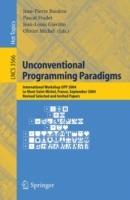
Unconventional Programming Paradigms: International Workshop UPP 2004, Le Mont Saint Michel, France, September 15-17, 2004, Revised Selected and Invited Papers

67,90 €
+680
punti 
Venditore: Feltrinelli
Articolo acquistabile con Carta del Docente

Articolo acquistabile con Carta Cultura Giovani e Carta del Merito

Articolo acquistabile con Carta della Cultura

Paga con Klarna in 3 rate senza interessi per ordini superiori a 39 €

Dati e Statistiche
 Salvato in 0 liste dei desideri
Salvato in 0 liste dei desideri
Unconventional Programming Paradigms: International Workshop UPP 2004, Le Mont Saint Michel, France, September 15-17, 2004, Revised Selected and Invited Papers
Disponibilità in 2 settimane
67,90 €
67,90 €
Disponibilità in 2 settimane


Nowadays, developers have to face the proliferation of hardware and software environments, the increasing demands of the users, the growing number of p- grams and the sharing of information, competences and services thanks to the generalization ofdatabasesandcommunication networks. Aprogramisnomore a monolithic entity conceived, produced and ?nalized before being used. A p- gram is now seen as an open and adaptive frame, which, for example, can - namically incorporate services not foreseen by the initial designer. These new needs call for new control structures and program interactions. Unconventionalapproachestoprogramminghavelongbeendevelopedinv- iousnichesandconstituteareservoirofalternativewaystofacetheprogramming languages crisis. New models of programming (e. g. , bio-inspired computing, - ti?cialchemistry,amorphouscomputing,. . . )arealsocurrentlyexperiencinga renewed period of growth as they face speci?c needs and new application - mains. These approaches provide new abstractions and notations or develop new ways of interacting with programs. They are implemented by embedding new sophisticated data structures in a classical programming model (API), by extending an existing language with new constructs (to handle concurrency, - ceptions, open environments, . . . ), by conceiving new software life cycles and program executions (aspect weaving, run-time compilation) or by relying on an entire new paradigm to specify a computation. They are inspired by theoretical considerations (e. g. , topological, algebraic or logical foundations), driven by the domain at hand (domain-speci?c languages like PostScript, musical notation, animation, signal processing, etc. ) or by metaphors taken from various areas (quantum computing, computing with molecules, informationprocessing in - ological tissues, problem solving from nature, ethological and social modeling).
-
Curatore:
-
Editore:
-
Collana:Lecture Notes in Computer Science
-
Anno:2005
-
Rilegatura:Paperback / softback
Pagine:
367 p.
Testo in English
Dimensioni:
235 x 155 mm
EAN:
9783540278849

Informazioni e Contatti sulla Sicurezza dei Prodotti
Le schede prodotto sono aggiornate in conformità al Regolamento UE 988/2023. Laddove ci fossero taluni dati non disponibili per ragioni indipendenti da Feltrinelli, vi informiamo che stiamo compiendo ogni ragionevole sforzo per inserirli. Vi invitiamo a controllare periodicamente il sito www.lafeltrinelli.it per eventuali novità e aggiornamenti.
Per le vendite di prodotti da terze parti, ciascun venditore si assume la piena e diretta responsabilità per la commercializzazione del prodotto e per la sua conformità al Regolamento UE 988/2023, nonché alle normative nazionali ed europee vigenti.
Per informazioni sulla sicurezza dei prodotti, contattare productsafety@feltrinelli.it
