










LIBRO INGLESE





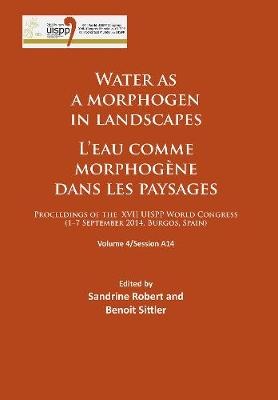
Water as a morphogen in landscapes/L’eau comme morphogène dans les paysages: Proceedings of the XVII UISPP World Congress (1–7 September 2014, Burgos, Spain) Volume 4/Session A14


32,50 €
+330
punti 
Venditore: Feltrinelli
Articolo acquistabile con Carta del Docente

Articolo acquistabile con Carta Cultura Giovani e Carta del Merito

Articolo acquistabile con Carta della Cultura

Dati e Statistiche
 Salvato in 0 liste dei desideri
Salvato in 0 liste dei desideri
Water as a morphogen in landscapes/L’eau comme morphogène dans les paysages: Proceedings of the XVII UISPP World Congress (1–7 September 2014, Burgos, Spain) Volume 4/Session A14
Disponibile in 5 gg lavorativi
32,50 €
32,50 €
Disponibile in 5 gg lavorativi



These proceedings include eight presentations. Two of them focus on the role played by the river axes and the geography of river basins as factors of circulation and settlement of Palaeolithic hunter gatherers on the European scale (Francois Djindjian) and in the surroundings of the Jura Mountains (Gérald Bereiziat and Harald Floss). José Javier Piña Abellán describes how the central valley of the River Jabalón (Ciudad Real, Spain) was peopled in the course of the second millennium B.C., and how the inhabitants still maintain a close link to the hydrography. Frederic Cruz and Christophe Petit provide new insights into the organization of the princely residences’ territories of the late Hallstatt era in the North-Western region of the Alps, taking into account their relationship to the environment, and especially the distance from the valleys. Ana Lucia Herberts documents how river crossings and related drainage structures played a crucial role in setting cattle trails in Brazil to drive the cattle from their pasture lands to the major market places in remote cities. A 3-D modelling using LiDAR altimetry has been used by Sabine Schellberg, Benoît Sittler, and Werner Konold to reconstruct water meadows that were used in historical times in the upper Rhine Valley. In their paper, Sandrine Robert and Hélène Noizet develop, as an example illustrating resilience, how an ancient meander of the River Seine, which was filled in Antiquity, still dictates the layout of the network of the streets of Paris. Lastly, Martin Orgaz and Norma Ratto addressed the social construction of landscapes by relating Inca sites to the Tinogasta region (Catamarca, Argentina) rivers whose visual features (the colour red) may be regarded as a factor that governed the selection of sites.
-
Curatore:
-
Editore:
-
Collana:Proceedings of the UISPP World Congress
-
Anno:2016
-
Rilegatura:Paperback / softback
Pagine:
120 p.
Testo in French
Dimensioni:
290 x 205 mm
Peso:
950 gr.
EAN:
9781784912871

Informazioni e Contatti sulla Sicurezza dei Prodotti
Le schede prodotto sono aggiornate in conformità al Regolamento UE 988/2023. Laddove ci fossero taluni dati non disponibili per ragioni indipendenti da Feltrinelli, vi informiamo che stiamo compiendo ogni ragionevole sforzo per inserirli. Vi invitiamo a controllare periodicamente il sito www.lafeltrinelli.it per eventuali novità e aggiornamenti.
Per le vendite di prodotti da terze parti, ciascun venditore si assume la piena e diretta responsabilità per la commercializzazione del prodotto e per la sua conformità al Regolamento UE 988/2023, nonché alle normative nazionali ed europee vigenti.
Per informazioni sulla sicurezza dei prodotti, contattare productsafety@feltrinelli.it
