









EBOOK IN LINGUA STRANIERA





Anaphora Resolution

131,03 €
+1310
punti 
Venditore: Feltrinelli

Acquista online
Scaricabile subito
Articolo acquistabile con Carta del Docente

Articolo acquistabile con Carta Cultura Giovani e Carta del Merito

Articolo acquistabile con Carta della Cultura

Dati e Statistiche
 Salvato in 0 liste dei desideri
Salvato in 0 liste dei desideri
Anaphora Resolution
Scaricabile subito
131,03 €
131,03 €
Scaricabile subito
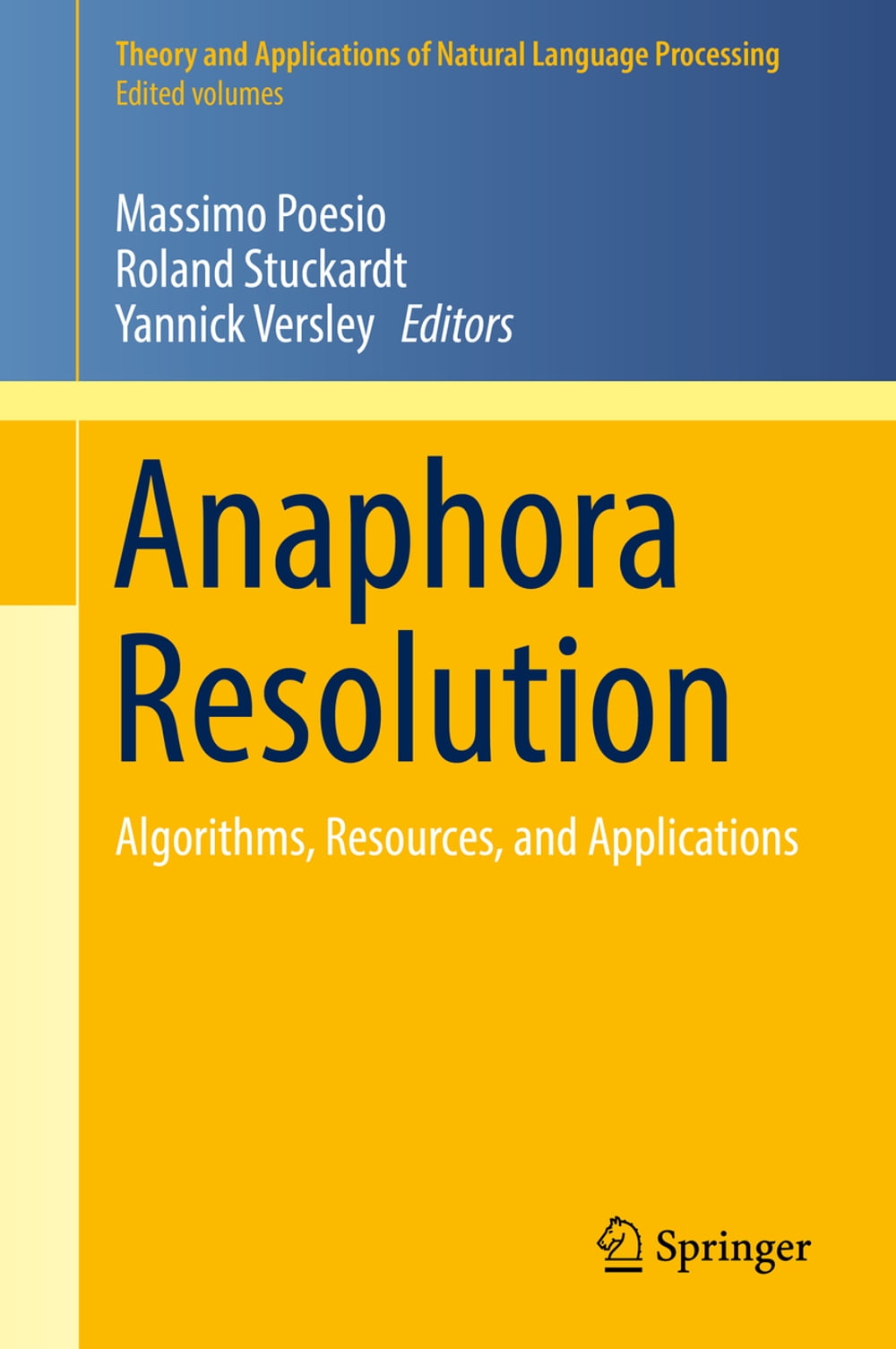


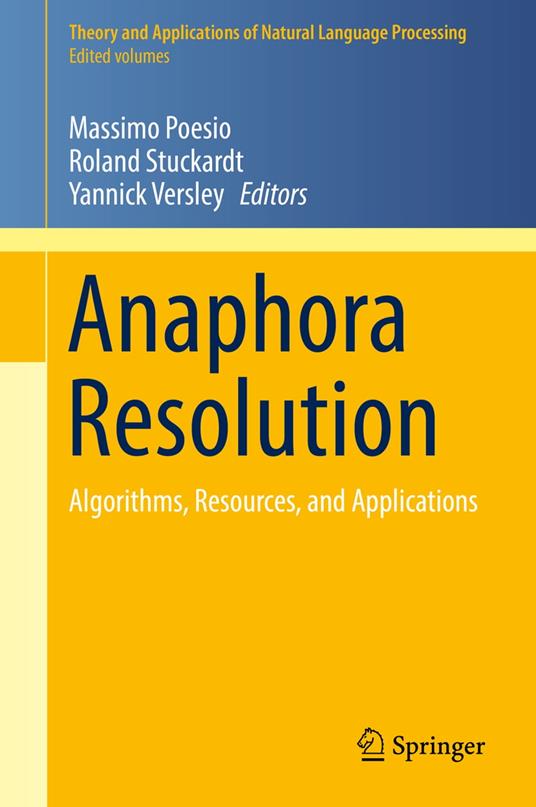
This book lays out a path leading from the linguistic and cognitive basics, to classical rule-based and machine learning algorithms, to today’s state-of-the-art approaches, which use advanced empirically grounded techniques, automatic knowledge acquisition, and refined linguistic modeling to make a real difference in real-world applications. Anaphora and coreference resolution both refer to the process of linking textual phrases (and, consequently, the information attached to them) within as well as across sentence boundaries, and to the same discourse referent. The book offers an overview of recent research advances, focusing on practical, operational approaches and their applications. In part I (Background), it provides a general introduction, which succinctly summarizes the linguistic, cognitive, and computational foundations of anaphora processing and the key classical rule- and machine-learning-based anaphora resolution algorithms. Acknowledging the central importance ofshared resources, part II (Resources) covers annotated corpora, formal evaluation, preprocessing technology, and off-the-shelf anaphora resolution systems. Part III (Algorithms) provides a thorough description of state-of-the-art anaphora resolution algorithms, covering enhanced machine learning methods as well as techniques for accomplishing important subtasks such as mention detection and acquisition of relevant knowledge. Part IV (Applications) deals with a selection of important anaphora and coreference resolution applications, discussing particular scenarios in diverse domains and distilling a best-practice model for systematically approaching new application cases. In the concluding part V (Outlook), based on a survey conducted among the contributing authors, the prospects of the research field of anaphora processing are discussed, and promising new areas of interdisciplinary cooperation and emerging application scenarios are identified. Given the book’s design,it can be used both as an accompanying text for advanced lectures in computational linguistics, natural language engineering, and computer science, and as a reference work for research and independent study. It addresses an audience that includes academic researchers, university lecturers, postgraduate students, advanced undergraduate students, industrial researchers, and software engineers.
-
Curatore:
-
Anno edizione:2016
-
Editore:
-
Formato:
Lingua:
Inglese
Compatibilità:
Tutti i dispositivi (eccetto Kindle) Scopri di più
Layout:
Reflowable
EAN:
9783662479094

Formato:
Gli eBook venduti da Feltrinelli.it sono in formato ePub e possono essere protetti da Adobe DRM. In caso di download di un file protetto da DRM si otterrà un file in formato .acs, (Adobe Content Server Message), che dovrà essere aperto tramite Adobe Digital Editions e autorizzato tramite un account Adobe, prima di poter essere letto su pc o trasferito su dispositivi compatibili.
Cloud:
Gli eBook venduti da Feltrinelli.it sono sincronizzati automaticamente su tutti i client di lettura Kobo successivamente all’acquisto. Grazie al Cloud Kobo i progressi di lettura, le note, le evidenziazioni vengono salvati e sincronizzati automaticamente su tutti i dispositivi e le APP di lettura Kobo utilizzati per la lettura.
Clicca qui per sapere come scaricare gli ebook utilizzando un pc con sistema operativo Windows
