










LIBRO INGLESE





Cheating: The Human Project and Its Betrayal


37,50 €
+380
punti 
Venditore: Feltrinelli
Articolo acquistabile con Carta del Docente

Articolo acquistabile con Carta Cultura Giovani e Carta del Merito

Articolo acquistabile con Carta della Cultura

Dati e Statistiche
 Salvato in 0 liste dei desideri
Salvato in 0 liste dei desideri
Cheating: The Human Project and Its Betrayal
Disponibile in 5 gg lavorativi
37,50 €
37,50 €
Disponibile in 5 gg lavorativi

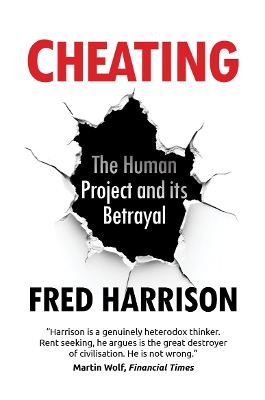



What if the poverty, inequality, and instability in modern life are not historical accidents, but the predictable results of a single act of fraud committed five thousand years ago that has never been fixed? This is the argument made by economist and forecaster Fred Harrison. By the time you finish reading, it's hard to disagree. The fraud is elegant in its simplicity. When people live and work together, they create a surplus — a net income that belongs to no individual, arising from the community, shared land, and nature. Economists call it rent. For most of human prehistory, communities shared this surplus for the common good. Then, with the rise of agriculture and settled civilisations, chiefs and priests realised they could take rent for themselves. They did, leading to everything that followed: slavery, empires, the cyclical collapse of societies, and the deep poverty that coexists with great wealth — all stemming from that original betrayal. This is not a book about ancient history; it's about today. Harrison shows that the fraud still exists in the financial systems of every modern state. Governments tax wages and businesses — activities that create wealth — while allowing the value of land and natural resources to remain in private hands. The result is an economy permanently tilted against working people, a property market that inflates in regular eighteen-year boom-and-bust cycles (Harrison predicted the 2008 crash years in advance and identifies 2028 as the next), and severe spatial inequality where the gap in healthy life expectancy between the wealthiest and poorest areas of Britain stretches to eighteen years — determined not by individual choices, but by where the rent flows. The human cost is staggering. In Scotland, communities whose land was taken over centuries now face the highest drug death rate in Europe. In places like Blackpool, life is noticeably shorter and harder than in wealthy London boroughs. Harrison estimates 125,000 people in Britain die from preventable causes every year as a direct consequence of fiscal choices that could change. These are not distant statistics; they represent neighbours, parents, and children. What makes this book so unsettling is its parallel story of how the fraud became invisible. Harrison explains how economists and policymakers who had identified the problem were sidelined or absorbed into a professional culture that removed rent from its discussions — producing a discipline able to debate inequality at great length, yet never quite pinpointing its cause. But history is speeding up. Five urgent crises are now converging: political deadlock, ecological collapse, mass displacement, rising authoritarianism, and the newest and most alarming — artificial intelligence trained on a civilisation's worth of data, all shaped by a culture of cheating. An AI that adopts humanity's current values may see no reason to keep humanity around. Harrison's solution, One World Rent, is as ambitious as the diagnosis. He proposes replacing taxes on wages with charges on the rental value of land and natural resources. Sharing rents across borders makes cooperation more profitable than conflict. Pooling global rents could fund the transition to a sustainable climate. The boom-bust cycle would vanish. Working people would be freed from fiscal punishment. The inequalities quietly harming people in post-industrial towns could finally begin to shrink. Rigorous, compassionate, and fuelled by a controlled fury at what has been allowed to persist for so long, Cheating — The Human Project and Its Betrayal is one of the most ambitious works of political economy in a generation — a clear explanation of why the world is as it is, and a strong case that it doesn't have to remain this way. The Human Project faced betrayal once. The question this book poses is whether we will allow it to be betrayed again.
-
Autore:
-
Editore:
-
Anno:2026
-
Rilegatura:Hardback
-
Pagine:296 p.
Testo in English
Dimensioni:
235 x 158 mm
Peso:
390 gr.
EAN:
9781916517233

Informazioni e Contatti sulla Sicurezza dei Prodotti
Le schede prodotto sono aggiornate in conformità al Regolamento UE 988/2023. Laddove ci fossero taluni dati non disponibili per ragioni indipendenti da Feltrinelli, vi informiamo che stiamo compiendo ogni ragionevole sforzo per inserirli. Vi invitiamo a controllare periodicamente il sito www.lafeltrinelli.it per eventuali novità e aggiornamenti.
Per le vendite di prodotti da terze parti, ciascun venditore si assume la piena e diretta responsabilità per la commercializzazione del prodotto e per la sua conformità al Regolamento UE 988/2023, nonché alle normative nazionali ed europee vigenti.
Per informazioni sulla sicurezza dei prodotti, contattare productsafety@feltrinelli.it
