










LIBRO INGLESE





Fourier and Wavelet Analysis


67,10 €
+670
punti 
Venditore: Feltrinelli
Articolo acquistabile con Carta del Docente

Articolo acquistabile con Carta Cultura Giovani e Carta del Merito

Articolo acquistabile con Carta della Cultura

Paga con Klarna in 3 rate senza interessi per ordini superiori a 39 €

Dati e Statistiche
 Salvato in 0 liste dei desideri
Salvato in 0 liste dei desideri
Fourier and Wavelet Analysis
Disponibilità in 2 settimane
67,10 €
67,10 €
Disponibilità in 2 settimane

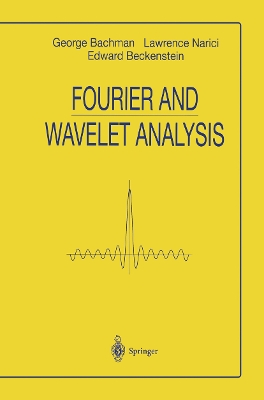



globalized Fejer's theorem; he showed that the Fourier series for any f E Ld-7I", 7I"] converges (C, 1) to f (t) a.e. The desire to do this was part of the reason that Lebesgue invented his integral; the theorem mentioned above was one of the first uses he made of it (Sec. 4.18). Denjoy, with the same motivation, extended the integral even further. Concurrently, the emerging point of view that things could be decom posed into waves and then reconstituted infused not just mathematics but all of science. It is impossible to quantify the role that this perspective played in the development of the physics of the nineteenth and twentieth centuries, but it was certainly great. Imagine physics without it. We develop the standard features of Fourier analysis-Fourier series, Fourier transform, Fourier sine and cosine transforms. We do NOT do it in the most elegant way. Instead, we develop it for the reader who has never seen them before. We cover more recent developments such as the discrete and fast Fourier transforms and wavelets in Chapters 6 and 7. Our treatment of these topics is strictly introductory, for the novice. (Wavelets for idiots?) To do them properly, especially the applications, would take at least a whole book.
-
Autore:
-
Editore:
-
Collana:Universitext
-
Anno:2012
-
Rilegatura:Paperback / softback
Pagine:
507 p.
Testo in English
Dimensioni:
235 x 155 mm
EAN:
9781461267935

Informazioni e Contatti sulla Sicurezza dei Prodotti
Le schede prodotto sono aggiornate in conformità al Regolamento UE 988/2023. Laddove ci fossero taluni dati non disponibili per ragioni indipendenti da Feltrinelli, vi informiamo che stiamo compiendo ogni ragionevole sforzo per inserirli. Vi invitiamo a controllare periodicamente il sito www.lafeltrinelli.it per eventuali novità e aggiornamenti.
Per le vendite di prodotti da terze parti, ciascun venditore si assume la piena e diretta responsabilità per la commercializzazione del prodotto e per la sua conformità al Regolamento UE 988/2023, nonché alle normative nazionali ed europee vigenti.
Per informazioni sulla sicurezza dei prodotti, contattare productsafety@feltrinelli.it
