










LIBRO INGLESE





ISCS 2013: Interdisciplinary Symposium on Complex Systems


129,50 €
+1300
punti 
Venditore: Feltrinelli
Articolo acquistabile con Carta del Docente

Articolo acquistabile con Carta Cultura Giovani e Carta del Merito

Articolo acquistabile con Carta della Cultura

Paga con Klarna in 3 rate senza interessi per ordini superiori a 39 €

Dati e Statistiche
 Salvato in 0 liste dei desideri
Salvato in 0 liste dei desideri
ISCS 2013: Interdisciplinary Symposium on Complex Systems
Disponibilità in 2 settimane
129,50 €
129,50 €
Disponibilità in 2 settimane

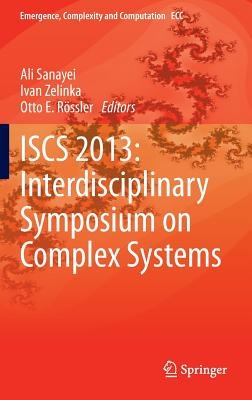



The book you hold in your hands is the outcome of the "ISCS 2013: Interdisciplinary Symposium on Complex Systems" held at the historical capital of Bohemia as a continuation of our series of symposia in the science of complex systems. Prague, one of the most beautiful European cities, has its own beautiful genius loci. Here, a great number of important discoveries were made and many important scientists spent fruitful and creative years to leave unforgettable traces. The perhaps most significant period was the time of Rudolf II who was a great supporter of the art and the science and attracted a great number of prominent minds to Prague. This trend would continue. Tycho Brahe, Niels Henrik Abel, Johannes Kepler, Bernard Bolzano, August Cauchy Christian Doppler, Ernst Mach, Albert Einstein and many others followed developing fundamental mathematical and physical theories or expanding them. Thus in the beginning of the 17th century, Kepler formulated here the first two of his three laws of planetary motion on the basis of Tycho Brahe’s observations. In the 19th century, nowhere differentiable continuous functions (of a fractal character) were constructed here by Bolzano along with a treatise on infinite sets, titled “Paradoxes of Infinity” (1851). Weierstrass would later publish a similar function in 1872. In 1842, Doppler as a professor of mathematics at the Technical University of Prague here first lectured about a physical effect to bear his name later. And the epoch-making physicist Albert Einstein – while being a chaired professor of theoretical physics at the German University of Prague – arrived at the decisive steps of his later finished theory of general relativity during the years 1911–1912. In Prague, also many famous philosophers and writers accomplished their works; for instance, playwright arel ape coined the word "robot" in Prague (“robot” comes from the Czech word “robota” which means “forced labor”).
-
Curatore:
-
Editore:
-
Collana:Emergence, Complexity and Computation
-
Anno:2014
-
Rilegatura:Hardback
Pagine:
400 p.
Testo in English
Dimensioni:
235 x 155 mm
EAN:
9783642454370

Informazioni e Contatti sulla Sicurezza dei Prodotti
Le schede prodotto sono aggiornate in conformità al Regolamento UE 988/2023. Laddove ci fossero taluni dati non disponibili per ragioni indipendenti da Feltrinelli, vi informiamo che stiamo compiendo ogni ragionevole sforzo per inserirli. Vi invitiamo a controllare periodicamente il sito www.lafeltrinelli.it per eventuali novità e aggiornamenti.
Per le vendite di prodotti da terze parti, ciascun venditore si assume la piena e diretta responsabilità per la commercializzazione del prodotto e per la sua conformità al Regolamento UE 988/2023, nonché alle normative nazionali ed europee vigenti.
Per informazioni sulla sicurezza dei prodotti, contattare productsafety@feltrinelli.it
