









LIBRO INGLESE





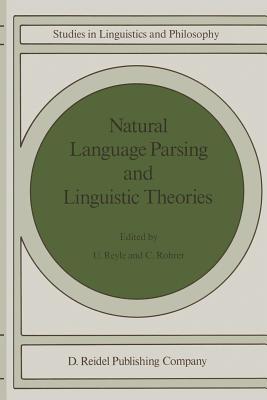
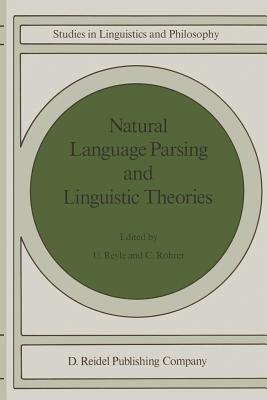
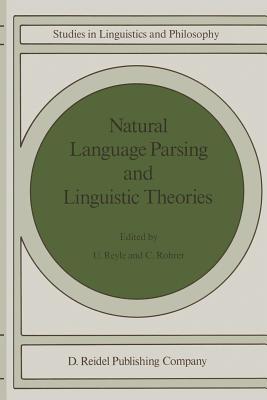
Natural Language Parsing and Linguistic Theories


66,90 €
+670
punti 
Venditore: Feltrinelli
Articolo acquistabile con Carta del Docente

Articolo acquistabile con Carta Cultura Giovani e Carta del Merito

Articolo acquistabile con Carta della Cultura

Paga con Klarna in 3 rate senza interessi per ordini superiori a 39 €

Dati e Statistiche
 Salvato in 0 liste dei desideri
Salvato in 0 liste dei desideri
Natural Language Parsing and Linguistic Theories
Disponibilità in 2 settimane
66,90 €
66,90 €
Disponibilità in 2 settimane


presupposition fails, we now give a short introduction into Unification Grammar. Since all implementations discussed in this volume use PROLOG (with the exception of BlockjHaugeneder), we felt that it would also be useful to explain the difference between unification in PROLOG and in UG. After the introduction to UG we briefly summarize the main arguments for using linguistic theories in natural language processing. We conclude with a short summary of the contributions to this volume. UNIFICATION GRAMMAR 3 Feature Structures or Complex Categories. Unification Grammar was developed by Martin Kay (Kay 1979). Martin Kay wanted to give a precise defmition (and implementation) of the notion of 'feature'. Linguists use features at nearly all levels of linguistic description. In phonetics, for instance, the phoneme b is usually described with the features 'bilabial', 'voiced' and 'nasal'. In the case of b the first two features get the value +, the third (nasal) gets the value -. Feature value pairs in phonology are normally represented as a matrix. bilabial: + voiced: + I nasal: - [Feature matrix for b.] In syntax features are used, for example, to distinguish different noun classes. The Latin noun 'murus' would be characterized by the following feature-value pairs: gender: masculin, number: singular, case: nominative, pred: murus. Besides a matrix representation one frequently fmds a graph representation for feature value pairs. The edges of the graph are labelled by features. The leaves denote the value of a feature.
-
Curatore:
-
Editore:
-
Collana:Studies in Linguistics and Philosophy
-
Anno:1988
-
Rilegatura:Paperback / softback
Pagine:
486 p.
Testo in English
Dimensioni:
229 x 152 mm
EAN:
9781556080562

Informazioni e Contatti sulla Sicurezza dei Prodotti
Le schede prodotto sono aggiornate in conformità al Regolamento UE 988/2023. Laddove ci fossero taluni dati non disponibili per ragioni indipendenti da Feltrinelli, vi informiamo che stiamo compiendo ogni ragionevole sforzo per inserirli. Vi invitiamo a controllare periodicamente il sito www.lafeltrinelli.it per eventuali novità e aggiornamenti.
Per le vendite di prodotti da terze parti, ciascun venditore si assume la piena e diretta responsabilità per la commercializzazione del prodotto e per la sua conformità al Regolamento UE 988/2023, nonché alle normative nazionali ed europee vigenti.
Per informazioni sulla sicurezza dei prodotti, contattare productsafety@feltrinelli.it
