










EBOOK IN LINGUA STRANIERA





Programming Minds: The Science and Systems of Subconscious Influence

3,49 €
+30
punti 
Venditore: Feltrinelli

Acquista online
Scaricabile subito
Articolo acquistabile con Carta del Docente

Articolo acquistabile con Carta Cultura Giovani e Carta del Merito

Articolo acquistabile con Carta della Cultura

Abbonati a Kobo plus per avere accesso illimitato a questo contenuto

Dati e Statistiche
 Salvato in 0 liste dei desideri
Salvato in 0 liste dei desideri
Programming Minds: The Science and Systems of Subconscious Influence
Scaricabile subito
3,49 €
3,49 €
Scaricabile subito

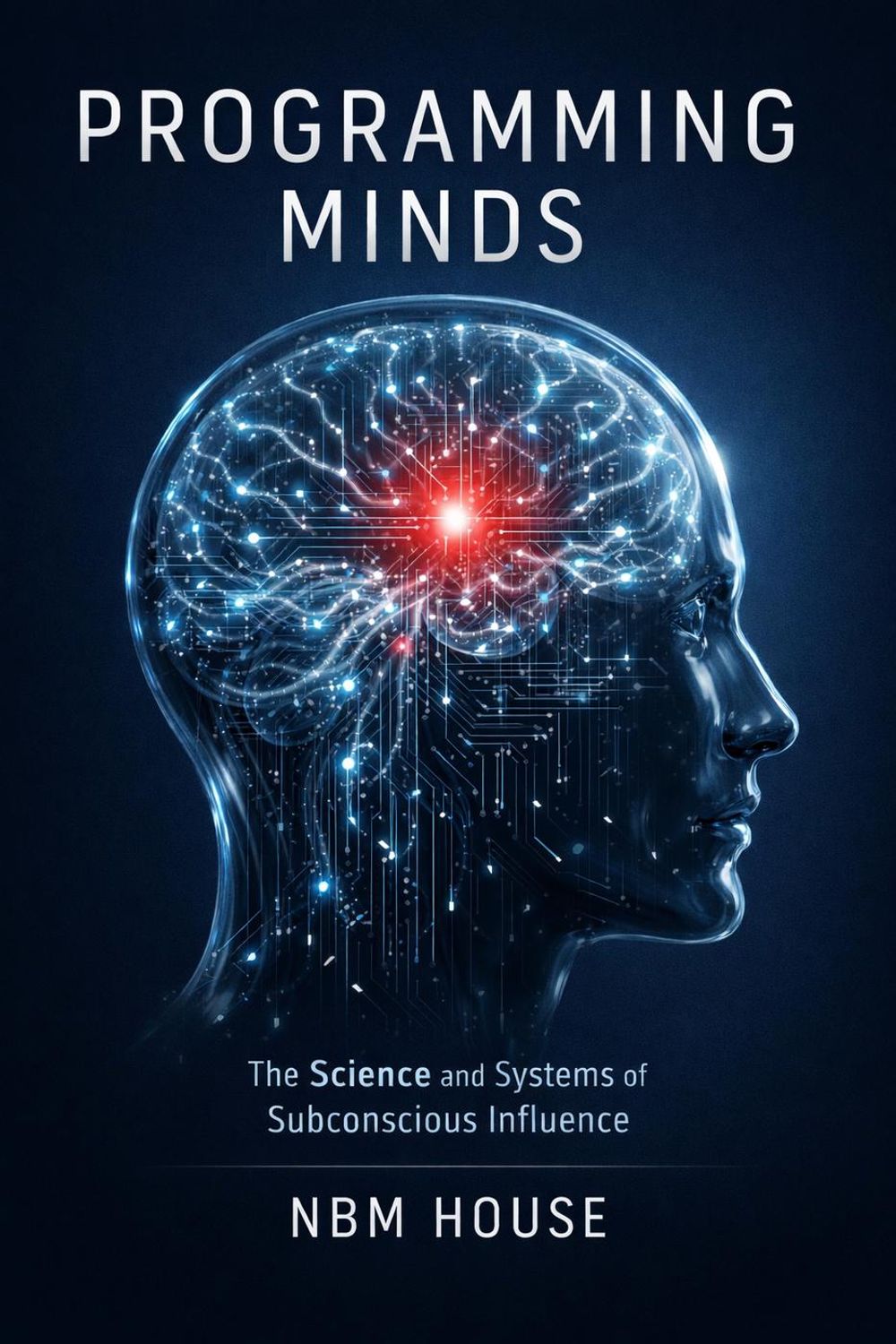


Programming Minds: The Science and Systems of Subconscious Influence Your brain doesn't just react to the world—it predicts it. Every perception, decision, and habit is shaped by a ceaseless process of anticipation and error correction. This predictive machinery makes us efficient… and extraordinarily vulnerable. In an age of infinite scrolls, algorithmic feeds, personalized notifications, and synthetic media, the environments we inhabit are no longer neutral. They are engineered to exploit the very mechanisms that make human cognition fast, automatic, and largely subconscious. Drawing on predictive processing, dual-process theories (System 1 and System 2), reward learning, priming, framing, anchoring, and behavioral economics, Programming Minds reveals how: • Platforms hijack attention through variable rewards and infinite scroll • Recommendation algorithms create filter bubbles and amplify outrage for engagement • Dark patterns, defaults, and microtargeting steer behavior without overt coercion • Social proof, reciprocity, scarcity, and authority operate below conscious scrutiny • Cognitive niches extended by search engines, GPS, and AI prosthetics reshape what we can think From the neuroscience of prediction error to the political economy of surveillance capitalism, this book maps the infrastructure of influence in the 21st century. It examines how asymmetry—platforms know us better than we know ourselves—erodes autonomy, fragments shared reality, and tightens behavioral loops. Yet influence is not omnipotent. Habituation, reactance, adversarial adaptation, and biological limits constrain even the most sophisticated systems. If you've read Thinking, Fast and Slow by Daniel Kahneman, The Age of Surveillance Capitalism by Shoshana Zuboff, Weapons of Math Destruction by Cathy O'Neil, Irresistible by Adam Alter, or Hooked by Nir Eyal, Programming Minds takes the next step: integrating the science of the predictive brain with the architecture of digital influence to explain how our minds are being programmed—and what can be done about it. Contents include: • Human cognition as predictive system • Conscious vs. subconscious processing • Mechanisms of influence (priming to defaults) • Mediated attention and behavioral steering • Symbolic environments and cognitive niches • AI, synthetic media, and the cognitive ecology of the 21st century • Limits of influence and paths to resistance Wake up to the systems shaping your predictions. Understand the architecture before it fully understands you. Perfect for readers interested in cognitive psychology, neuroscience, behavioral economics, social media addiction, algorithmic bias, digital ethics, attention economy, and the future of human autonomy. Start reading today—before the next notification pulls you away.
-
Autore:
-
Anno edizione:2026
-
Editore:
-
Formato:
-
Lingua:Inglese
Compatibilità:
Tutti i dispositivi (eccetto Kindle) Scopri di più
Layout:
Reflowable
EAN:
9798224301355

Formato:
Gli eBook venduti da Feltrinelli.it sono in formato ePub e possono essere protetti da Adobe DRM. In caso di download di un file protetto da DRM si otterrà un file in formato .acs, (Adobe Content Server Message), che dovrà essere aperto tramite Adobe Digital Editions e autorizzato tramite un account Adobe, prima di poter essere letto su pc o trasferito su dispositivi compatibili.
Cloud:
Gli eBook venduti da Feltrinelli.it sono sincronizzati automaticamente su tutti i client di lettura Kobo successivamente all’acquisto. Grazie al Cloud Kobo i progressi di lettura, le note, le evidenziazioni vengono salvati e sincronizzati automaticamente su tutti i dispositivi e le APP di lettura Kobo utilizzati per la lettura.
Clicca qui per sapere come scaricare gli ebook utilizzando un pc con sistema operativo Windows
