










EBOOK IN LINGUA STRANIERA





Quantum Infrastructure & Transmutation: The Reciprocity Engine

11,99 €
+120
punti 
Venditore: Feltrinelli

Acquista online
Scaricabile subito
Articolo acquistabile con Carta del Docente

Articolo acquistabile con Carta Cultura Giovani e Carta del Merito

Articolo acquistabile con Carta della Cultura

Abbonati a Kobo plus per avere accesso illimitato a questo contenuto

Dati e Statistiche
 Salvato in 0 liste dei desideri
Salvato in 0 liste dei desideri
Quantum Infrastructure & Transmutation: The Reciprocity Engine
Scaricabile subito
11,99 €
11,99 €
Scaricabile subito

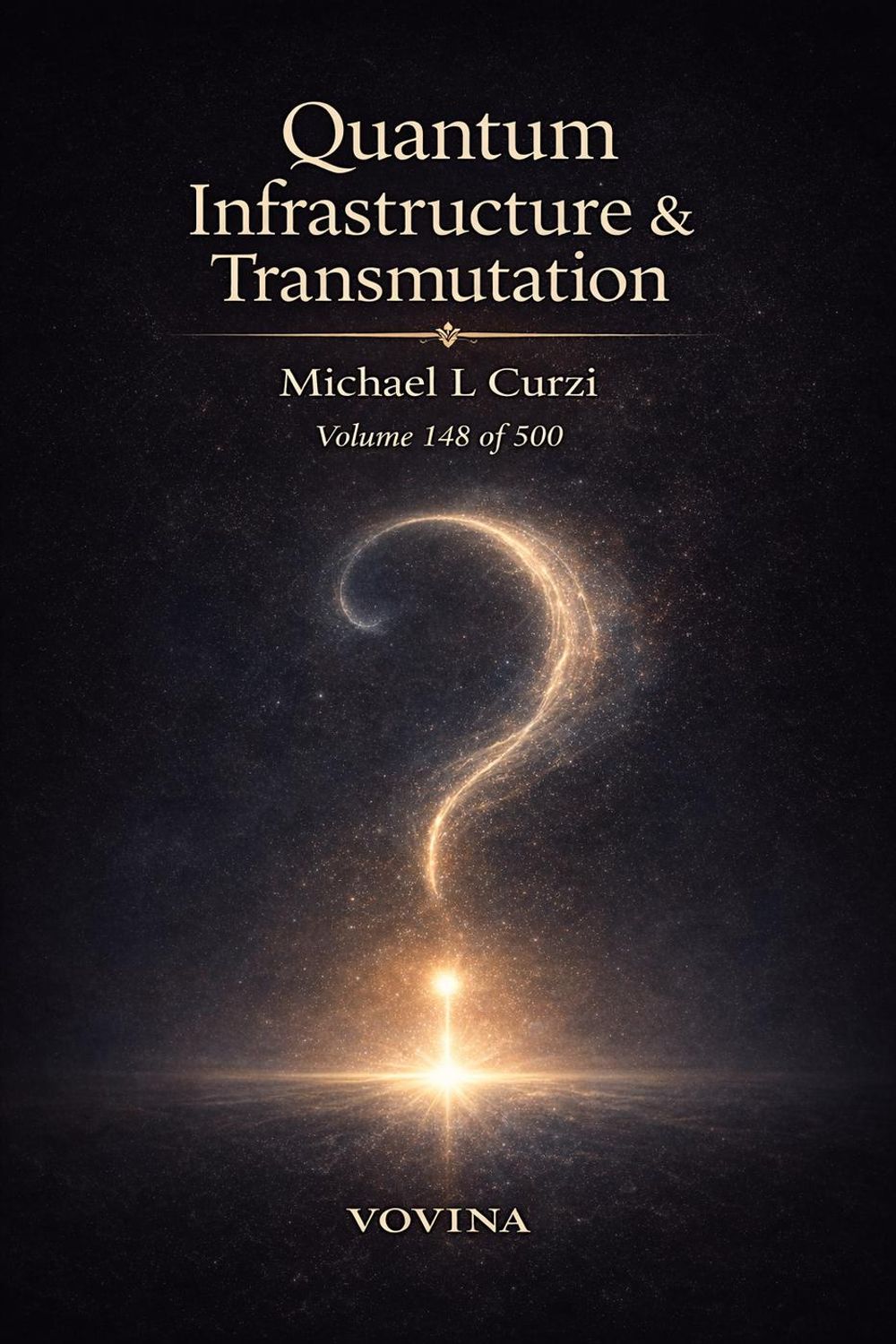



Quantum Infrastructure & Transmutation: The Reciprocity Engine is Book 148 in Michael L. Curzi's 500-volume philosophical and scientific canon, the Vovina Ontological OmniTautology. Situated within the Quantum Infrastructure & Transmutation series in the Physics & Energy branch of the project, the book examines how reciprocity—the exchange of force and information between systems—forms a fundamental principle linking physics, consciousness, and technological infrastructure. The volume centers on the Sanskrit root VAYU, meaning "to exchange force," interpreted here as the underlying mechanism by which physical systems, observers, and informational structures interact. Within the VOVINA framework, reciprocity is not merely a law of mechanics but a universal structural principle governing how reality organizes itself through interaction and feedback. Across nineteen chapters organized within the architectural structure used throughout the VOVINA canon, the book develops a layered inquiry progressing through observation (Drishti), discrimination (Viveka), application (Karma), connection (Bandhu), and integration (Moksha). This method bridges scientific analysis with contemplative insight, allowing theoretical ideas to evolve into experiential understanding. A central argument of the work is that many of the deepest problems in physics—including the quantum measurement problem—arise from an implicit assumption that observer and observed are separate systems. Within the VINO framework introduced here, observation is understood instead as a form of entanglement, in which the state of the observer becomes correlated with one branch of a system's possibilities. The text refers to this mechanism through the concept of a consciousness-coupling constant (?c) that links awareness with physical processes. The book also explores related principles including negative entropy as the driver of self-organization, the holographic nature of information in physical systems, and the role of light as a mediator between physical and informational domains. Through these concepts, Curzi suggests that the evolution of life, intelligence, and civilization can be understood as negentropic processes concentrating information and coherence within complex systems. Connections are drawn between modern theoretical physics, information theory, and contemplative philosophical traditions such as Advaita Vedanta. These interdisciplinary perspectives reveal recurring structural patterns suggesting that observer participation, information flow, and system reciprocity may be fundamental aspects of reality itself. Within the broader VOVINA canon, the volume contributes to the continuing investigation known as Variable X, the unresolved principle linking all five hundred volumes of the series. Rather than resolving this question directly, The Reciprocity Engine develops the conceptual tools necessary to approach it. By integrating physics, systems theory, and philosophical inquiry, Quantum Infrastructure & Transmutation: The Reciprocity Engine offers an ambitious exploration of how reciprocal interaction—between observer and universe, information and matter—may form the engine driving both scientific discovery and the evolution of consciousness.
-
Autore:
-
Anno edizione:2026
-
Editore:
-
Formato:
-
Lingua:Inglese
Compatibilità:
Tutti i dispositivi (eccetto Kindle) Scopri di più
Layout:
Reflowable
EAN:
9798903906475

Formato:
Gli eBook venduti da Feltrinelli.it sono in formato ePub e possono essere protetti da Adobe DRM. In caso di download di un file protetto da DRM si otterrà un file in formato .acs, (Adobe Content Server Message), che dovrà essere aperto tramite Adobe Digital Editions e autorizzato tramite un account Adobe, prima di poter essere letto su pc o trasferito su dispositivi compatibili.
Cloud:
Gli eBook venduti da Feltrinelli.it sono sincronizzati automaticamente su tutti i client di lettura Kobo successivamente all’acquisto. Grazie al Cloud Kobo i progressi di lettura, le note, le evidenziazioni vengono salvati e sincronizzati automaticamente su tutti i dispositivi e le APP di lettura Kobo utilizzati per la lettura.
Clicca qui per sapere come scaricare gli ebook utilizzando un pc con sistema operativo Windows
