










EBOOK IN LINGUA STRANIERA





Rule-based versus pattern-based morphology

5,99 €
+60
punti 
Venditore: Feltrinelli

Acquista online
Scaricabile subito
Articolo acquistabile con Carta del Docente

Articolo acquistabile con Carta Cultura Giovani e Carta del Merito

Articolo acquistabile con Carta della Cultura

Dati e Statistiche
 Salvato in 0 liste dei desideri
Salvato in 0 liste dei desideri
Rule-based versus pattern-based morphology
Scaricabile subito
5,99 €
5,99 €
Scaricabile subito

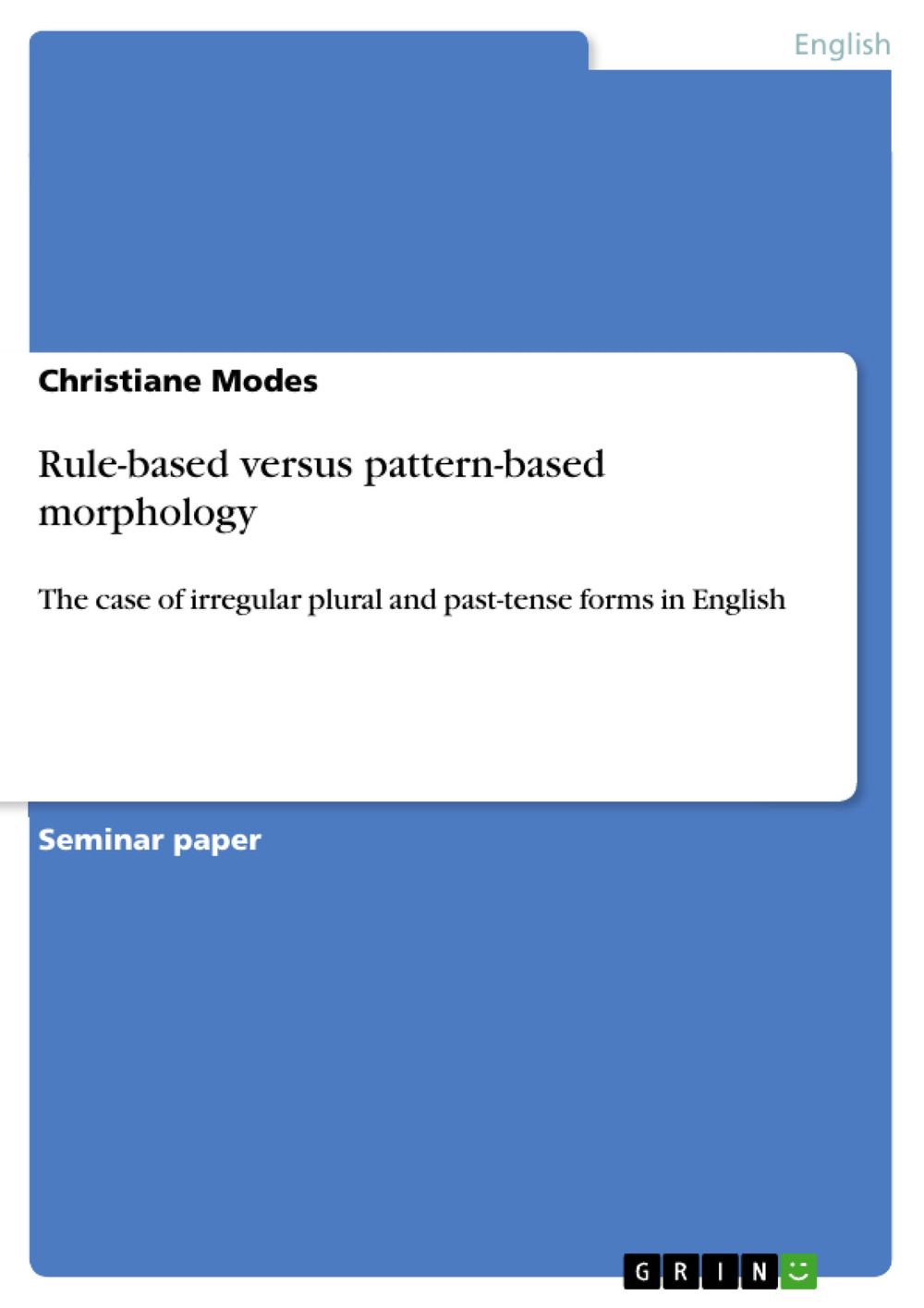



Seminar paper from the year 2013 in the subject English Language and Literature Studies - Linguistics, grade: 1,3, University of Würzburg, course: Lexicology, language: English, abstract: This paper deals mainly with the irregular forms of morphological inflection, namely the irregular past-tense forms and the irregular plurals in English. There are obviously two different models in the field of inflectional morphology which deal with these exceptional cases in different ways: the perspectives of ruled-based and pattern-based morphology. To describe these two approaches, a first definition should clear the most strikingly differences: in general, a rule is a given regulation to simplify and organise an action equally in each situation, to form a uniform and predictable product. A pattern is the product in reverse; it is the solution of an examination of different situations to find similarities in the process for adapting it to analogical situations. The question is: How do these approaches affect irregular inflection? Or the better question: How are they able to affect irregular plural and past-tense forms in English and where do they fail? This is up to the present a highly discussed problem in linguistics. Chapter 2 is about two morphological models: first the morpheme-based model, that regards each product as a sum of at least two morphemes that consist of a root and an affix modifying the root. The second part will present the word-based model that analyses the whole word as such to find out similarities (Bochner 1992 21-39). In Chapter 3 the advantages and disadvantages are discussed. Where do these models fit perfectly and in which cases do they fail or do have only partial validity? Chapter 4 will give a short introduction of a compromise of the two models. This theory combines advantages of both rule-based and pattern-based model, to eliminate or compensate failures the models have separated. The last chapter 5 is a conclusion to the discussed approaches, whether one model is more productive and therefore preferred. An outlook is discussed, whether a compromise or a combination of the two models is able to compensate the particular failures of each model or whether they rival to each other in a way that makes a combination impossible.
-
Autore:
-
Anno edizione:2014
-
Editore:
-
Formato:
-
Lingua:Inglese
Compatibilità:
Tutti i dispositivi (eccetto Kindle) Scopri di più
Layout:
Reflowable
EAN:
9783656586661

Formato:
Gli eBook venduti da Feltrinelli.it sono in formato ePub e possono essere protetti da Adobe DRM. In caso di download di un file protetto da DRM si otterrà un file in formato .acs, (Adobe Content Server Message), che dovrà essere aperto tramite Adobe Digital Editions e autorizzato tramite un account Adobe, prima di poter essere letto su pc o trasferito su dispositivi compatibili.
Cloud:
Gli eBook venduti da Feltrinelli.it sono sincronizzati automaticamente su tutti i client di lettura Kobo successivamente all’acquisto. Grazie al Cloud Kobo i progressi di lettura, le note, le evidenziazioni vengono salvati e sincronizzati automaticamente su tutti i dispositivi e le APP di lettura Kobo utilizzati per la lettura.
Clicca qui per sapere come scaricare gli ebook utilizzando un pc con sistema operativo Windows
