









EBOOK IN LINGUA STRANIERA





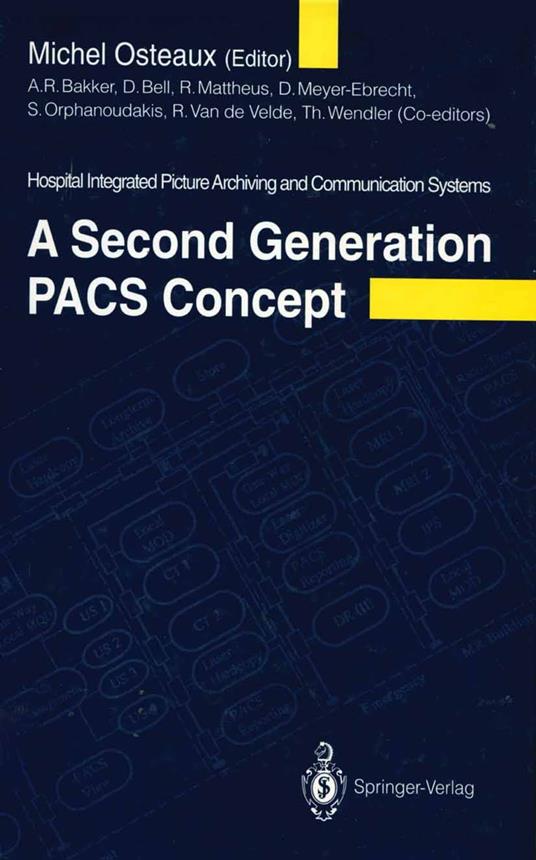
A Second Generation PACS Concept

46,79 €
+470
punti 
Venditore: Feltrinelli

Acquista online
Scaricabile subito
Articolo acquistabile con Carta del Docente

Articolo acquistabile con Carta Cultura Giovani e Carta del Merito

Articolo acquistabile con Carta della Cultura

Dati e Statistiche
 Salvato in 0 liste dei desideri
Salvato in 0 liste dei desideri
A Second Generation PACS Concept
Scaricabile subito
46,79 €
46,79 €
Scaricabile subito



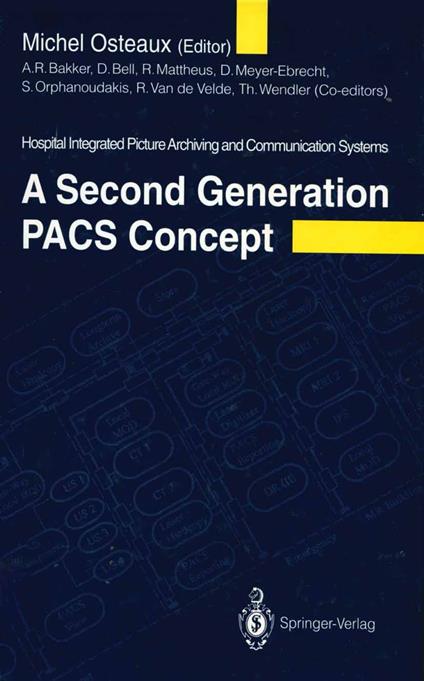
The term picture archiving and communications system (PACS) was initiated during the first International conference and workshop on the topic sponsored by The International Society for Optical Engineering (SPIE) in Newport Beach, California in 1982. The research and development (R&D) progress for PACS has been slow until 1988. The earlier PACS modules were mostly off the shelf components connected together to solve a very specific clinical problem. The three major players in PACS R&D are the European countries, United States of America, and Japan. For various reasons, the European coun tries concentrated in modeling and simulation, U.S.A. pre ferred in-house development or purchased PACS modules from a manufacturer, whereas Japan organized the PACS as a national project. Between 1989 and 1990 PACS R&D took a dramatic positive turn. Large scale P ACS projects were planned and some are of implementation, especially in newly con at various stages structed hospitals. Examples are the Hokkaido University, Japan; Hammersmith Hospital, United Kingdom; Social and Medical Center East (SMZO), Vienna, Austria; the U.S. Armed Force Medical Diagnostic Imaging Support (MDIS) project; and the UCLA Medical Plaza ambulatory care center. Another phenomenon is the organization of the EC-countries which provides a tremendous impetus for the European PACS R&D efforts. This book "Hospital Integrated Picture Archiving and Communication Systems: edited by Professor M. Osteaux and others is a direct product from these efforts.
-
Autore:
-
Anno edizione:2012
-
Editore:
-
Formato:
-
Lingua:Inglese
Compatibilità:
Tutti i dispositivi (eccetto Kindle) Scopri di più
Layout:
Reflowable
EAN:
9783642769634

Formato:
Gli eBook venduti da Feltrinelli.it sono in formato ePub e possono essere protetti da Adobe DRM. In caso di download di un file protetto da DRM si otterrà un file in formato .acs, (Adobe Content Server Message), che dovrà essere aperto tramite Adobe Digital Editions e autorizzato tramite un account Adobe, prima di poter essere letto su pc o trasferito su dispositivi compatibili.
Cloud:
Gli eBook venduti da Feltrinelli.it sono sincronizzati automaticamente su tutti i client di lettura Kobo successivamente all’acquisto. Grazie al Cloud Kobo i progressi di lettura, le note, le evidenziazioni vengono salvati e sincronizzati automaticamente su tutti i dispositivi e le APP di lettura Kobo utilizzati per la lettura.
Clicca qui per sapere come scaricare gli ebook utilizzando un pc con sistema operativo Windows
