










LIBRO INGLESE





Slow Onset Disasters: Linking Urban Built Environment and User-oriented Strategies to Assess and Mitigate Multiple Risks


62,20 €
+620
punti 
Venditore: Feltrinelli
Articolo acquistabile con Carta del Docente

Articolo acquistabile con Carta Cultura Giovani e Carta del Merito

Articolo acquistabile con Carta della Cultura

Paga con Klarna in 3 rate senza interessi per ordini superiori a 39 €

Dati e Statistiche
 Salvato in 0 liste dei desideri
Salvato in 0 liste dei desideri
Slow Onset Disasters: Linking Urban Built Environment and User-oriented Strategies to Assess and Mitigate Multiple Risks
Disponibilità in 2 settimane
62,20 €
62,20 €
Disponibilità in 2 settimane

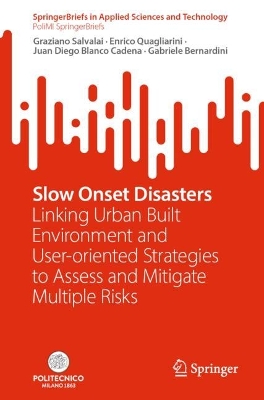



The book provides an overview of the Slow Onset Disasters (SLOD) in the urban built environment discussing potential strategies to assess and mitigate multiple climate change related risks. Climate change evidence has been reported in the last decades, suggesting that the anthropogenic activities are accelerating these changes towards a warmer and more polluted environment. In this context, SLODs have been linked to climate change related disasters and have been stated to have a higher impact risk within dense built environment (BE). Therefore, the book presents a description of the most relevant SLODs, their significance, and confluence, the way in which scientists and entities are monitoring their progression at different scales, a structured risk assessment strategy and the deconstruction of the BE characteristics that make it more prone to SLODs risk. In addition, it highlights the necessity of adapting the traditional risk assessment methods, to account for different vulnerability types, including the morphology and materiality of the BE, and the BE users’ characteristics. In fact, individual features influence users’ responses and tolerance to environmental stressors, because of age, health, gender, habits, and behaviour, thus impacting the users’ vulnerability. Exposure can then amplify these issues, since it defines the number of users that can be effectively affected by the SLOD. Starting from this perspective, the book first traces literature-based correlations between individual features, use behaviour, and individual response to the SLOD-altered open spaces. Then, a novel methodology, to quantify the variations of users’ vulnerability and exposure, is offered, to support designers in quickly defining input scenarios for risk assessment and mitigation. Lastly, it demonstrates, through a case study, the SLOD risk assessment framework proposed and the evaluation of the efficacy of risk mitigation strategies.
-
Autore:
-
Editore:
-
Collana:SpringerBriefs in Applied Sciences and Technology
-
Anno:2024
-
Rilegatura:Paperback / softback
-
Pagine:126 p.
Testo in English
Dimensioni:
235 x 155 mm
Peso:
225 gr.
EAN:
9783031520921

Informazioni e Contatti sulla Sicurezza dei Prodotti
Le schede prodotto sono aggiornate in conformità al Regolamento UE 988/2023. Laddove ci fossero taluni dati non disponibili per ragioni indipendenti da Feltrinelli, vi informiamo che stiamo compiendo ogni ragionevole sforzo per inserirli. Vi invitiamo a controllare periodicamente il sito www.lafeltrinelli.it per eventuali novità e aggiornamenti.
Per le vendite di prodotti da terze parti, ciascun venditore si assume la piena e diretta responsabilità per la commercializzazione del prodotto e per la sua conformità al Regolamento UE 988/2023, nonché alle normative nazionali ed europee vigenti.
Per informazioni sulla sicurezza dei prodotti, contattare productsafety@feltrinelli.it
