










EBOOK IN LINGUA STRANIERA





Vertex-Frequency Analysis of Graph Signals

140,39 €
+1400
punti 
Venditore: Feltrinelli

Acquista online
Scaricabile subito
Articolo acquistabile con Carta del Docente

Articolo acquistabile con Carta Cultura Giovani e Carta del Merito

Articolo acquistabile con Carta della Cultura

Dati e Statistiche
 Salvato in 0 liste dei desideri
Salvato in 0 liste dei desideri
Vertex-Frequency Analysis of Graph Signals
Scaricabile subito
140,39 €
140,39 €
Scaricabile subito

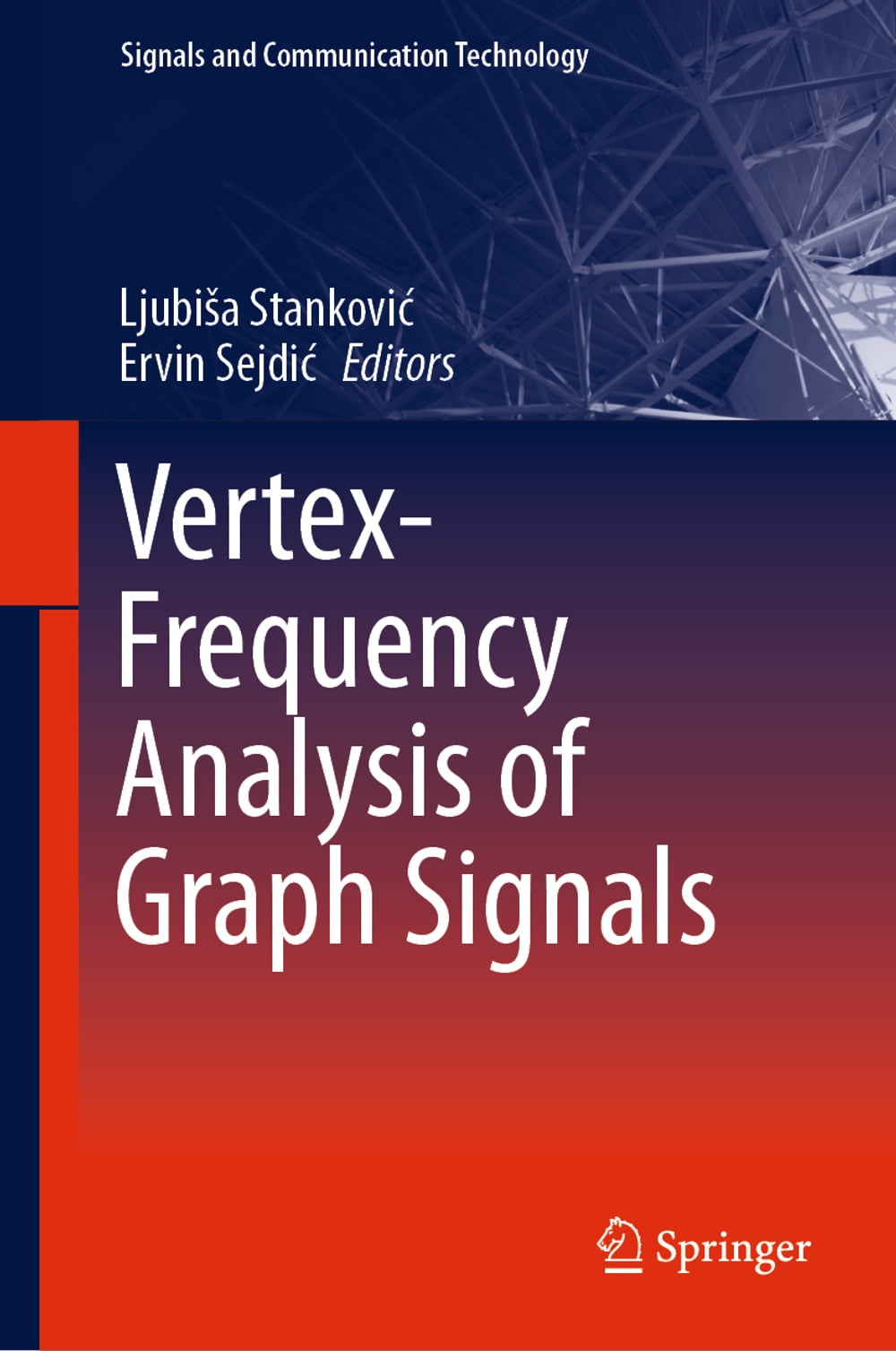



This book introduces new methods to analyze vertex-varying graph signals. In many real-world scenarios, the data sensing domain is not a regular grid, but a more complex network that consists of sensing points (vertices) and edges (relating the sensing points). Furthermore, sensing geometry or signal properties define the relation among sensed signal points. Even for the data sensed in the well-defined time or space domain, the introduction of new relationships among the sensing points may produce new insights in the analysis and result in more advanced data processing techniques. The data domain, in these cases and discussed in this book, is defined by a graph. Graphs exploit the fundamental relations among the data points. Processing of signals whose sensing domains are defined by graphs resulted in graph data processing as an emerging field in signal processing. Although signal processing techniques for the analysis of time-varying signals are well established, the corresponding graph signal processing equivalent approaches are still in their infancy. This book presents novel approaches to analyze vertex-varying graph signals. The vertex-frequency analysis methods use the Laplacian or adjacency matrix to establish connections between vertex and spectral (frequency) domain in order to analyze local signal behavior where edge connections are used for graph signal localization. The book applies combined concepts from time-frequency and wavelet analyses of classical signal processing to the analysis of graph signals. Covering analytical tools for vertex-varying applications, this book is of interest to researchers and practitioners in engineering, science, neuroscience, genome processing, just to name a few. It is also a valuable resource for postgraduate students and researchers looking to expand their knowledge of the vertex-frequency analysis theory and its applications. The book consists of 15 chapters contributed by 41 leading researches in the field.
-
Curatore:
-
Anno edizione:2018
-
Editore:
-
Formato:
Lingua:
Inglese
Compatibilità:
Tutti i dispositivi (eccetto Kindle) Scopri di più
Layout:
Reflowable
EAN:
9783030035747

Formato:
Gli eBook venduti da Feltrinelli.it sono in formato ePub e possono essere protetti da Adobe DRM. In caso di download di un file protetto da DRM si otterrà un file in formato .acs, (Adobe Content Server Message), che dovrà essere aperto tramite Adobe Digital Editions e autorizzato tramite un account Adobe, prima di poter essere letto su pc o trasferito su dispositivi compatibili.
Cloud:
Gli eBook venduti da Feltrinelli.it sono sincronizzati automaticamente su tutti i client di lettura Kobo successivamente all’acquisto. Grazie al Cloud Kobo i progressi di lettura, le note, le evidenziazioni vengono salvati e sincronizzati automaticamente su tutti i dispositivi e le APP di lettura Kobo utilizzati per la lettura.
Clicca qui per sapere come scaricare gli ebook utilizzando un pc con sistema operativo Windows
