










LIBRO INGLESE





Analytical Techniques for Studying the Physical Properties of Lipid Emulsions

69,00 €
+690
punti 
Venditore: Feltrinelli
Articolo acquistabile con Carta del Docente

Articolo acquistabile con Carta Cultura Giovani e Carta del Merito

Articolo acquistabile con Carta della Cultura

Paga con Klarna in 3 rate senza interessi per ordini superiori a 39 €

Dati e Statistiche
 Salvato in 0 liste dei desideri
Salvato in 0 liste dei desideri
Analytical Techniques for Studying the Physical Properties of Lipid Emulsions
Disponibilità in 2 settimane
69,00 €
69,00 €
Disponibilità in 2 settimane
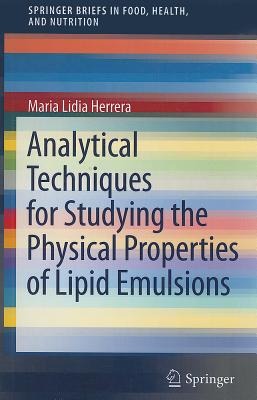


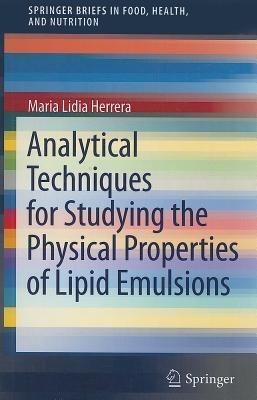
This book will review old and new methods to study emulsion stability and structure. Examples of emulsion-based foods include ice cream, yoghurt, and mayonnaise. The physicochemical properties of emulsions play an important role in food systems, as they directly contribute to the texture, sensory and nutritional properties of foods. One of the main properties is stability, which refers to the ability of an emulsion to resist physical changes over time. The development of an effective strategy to prevent undesirable changes in the properties of a particular food emulsion depends on the dominant physicochemical mechanism(s) responsible for the changes. In practice, two or more of these mechanisms may operate in concert. It is therefore important for food scientists to identify the relative importance of each mechanism, the relationship between them, and the factors that influence them, so that effective means of controlling the stability and physicochemical properties of emulsions can be established. Several techniques are used to study the physical behavior and structure of emulsions. Each technique has its advantages and disadvantages and provides different insights into the destabilization mechanisms. Among the oldest methods used to study emulsion stability is visual observation and small deformation rheometry. More recently, other techniques, such as ultrasound profiling, microscopy, droplet size distribution, and measurement of surface concentration to characterize adsorbed protein at the interface, have also been employed. Some of these techniques, such as droplet size distribution, involve some form of dilution. However, dilution disrupts some structures that play an important role in stability. The ability to study the stability of food emulsions in their undiluted form may reveal subtle nuances about their stability. Diffusing wave spectroscopy (DWS), laser scanning confocal microscopy (LSCM), nuclear magnetic resonance (NMR), and Turbiscan are among the more powerful, non-perturbing techniques used to characterized emulsions.
-
Autore:
-
Editore:
-
Collana:SpringerBriefs in Food, Health, and Nutrition
-
Anno:2012
-
Rilegatura:Paperback / softback
Pagine:
66 p.
Testo in English
Dimensioni:
235 x 155 mm
EAN:
9781461432555

Informazioni e Contatti sulla Sicurezza dei Prodotti
Le schede prodotto sono aggiornate in conformità al Regolamento UE 988/2023. Laddove ci fossero taluni dati non disponibili per ragioni indipendenti da Feltrinelli, vi informiamo che stiamo compiendo ogni ragionevole sforzo per inserirli. Vi invitiamo a controllare periodicamente il sito www.lafeltrinelli.it per eventuali novità e aggiornamenti.
Per le vendite di prodotti da terze parti, ciascun venditore si assume la piena e diretta responsabilità per la commercializzazione del prodotto e per la sua conformità al Regolamento UE 988/2023, nonché alle normative nazionali ed europee vigenti.
Per informazioni sulla sicurezza dei prodotti, contattare productsafety@feltrinelli.it
