










EBOOK IN LINGUA STRANIERA





Auditory and Visual Sensations

84,23 €
+840
punti 
Venditore: Feltrinelli

Acquista online
Scaricabile subito
Articolo acquistabile con Carta del Docente

Articolo acquistabile con Carta Cultura Giovani e Carta del Merito

Articolo acquistabile con Carta della Cultura

Dati e Statistiche
 Salvato in 0 liste dei desideri
Salvato in 0 liste dei desideri
Auditory and Visual Sensations
Scaricabile subito
84,23 €
84,23 €
Scaricabile subito

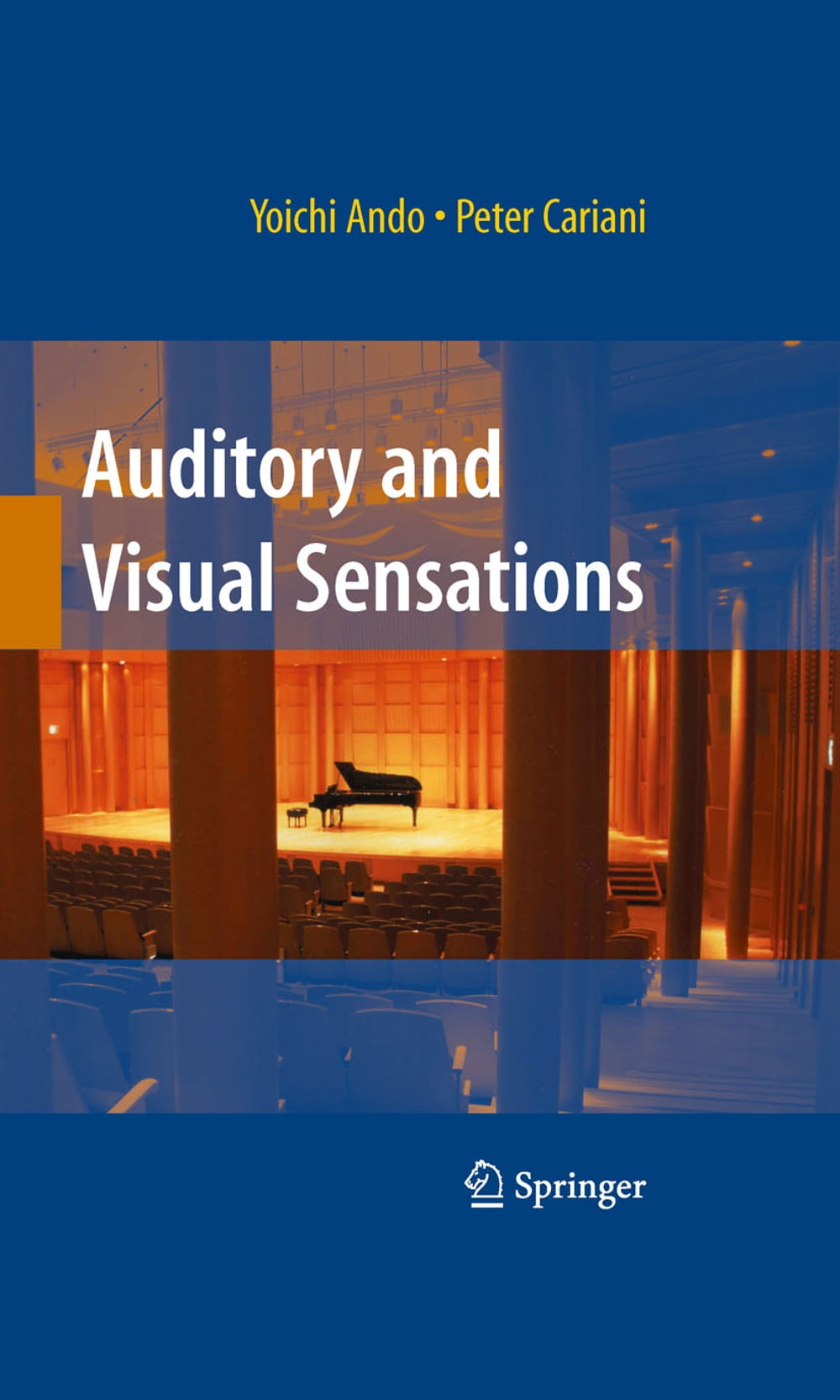


Ando establishes a theory of subjective preference of the sound field in a concert hall, based on preference theory with a model of human auditory-brain system. The model uses the autocorrelation function and the interaural crosscorrelation function for signals arriving at two ear entrances and considers the specialization of human cerebral hemispheres. The theory may be applied to describe primary sensations such as pitch or missing fundamental, loudness, timbre, and duration. These four primary sensations may be formulated by the temporal factors extracted from the autocorrelation function associated with left hemisphere. Spatial sensations such as localization in the horizontal plane, apparent source width, and subjective diffuseness are described by spatial factors extracted from the interaural crosscorrelation function associated with the right hemisphere. Any important subjective responses of sound fields may be described by use of both the temporal and spatial factors. The theory may also be applied to visual sensations as well as subjective preference of visual environments. Remarkable findings in activities in both auditory-brain and visual-brain systems in relation to subjective preference as a primitive response are described. Any other subjective responses of the source sound signal and the sound field can be described in terms of temporal and spatial factors. Part I of the book describes experimental results from basic research in acoustics, psychoacoustics, the psychology of auditory preferences, and auditory neurophysiology. Applications include optimal design of concert hall and opera house acoustics, architectural acoustics of speech intelligibility and musical expression, as well as the perception of noise and its annoyance. In Part II, temporal and spatial sensations in vision are described in terms of similar kinds of correlation-based representations. A seamless, general theory can be established for temporal and spatial aspects of vision that includes subjective preferences for visual environments. Many audio-visual analogies are drawn. A typical temporal sensation of vision is the "pitch" of a flickering light, for which the missing fundamental is perceived in a manner highly analogous to its acoustic counterpart. Visual spatial sensations include contrast, regularity and coarseness. A spatial "vibrato" in a drawing is demonstrated as an application of the theory in the visual arts. The reader is given a highly fleshed out strategy for architectural acoustical design that is grounded both in psychology and neuroscience. Few other works are as ambitious in attempting to understand and explain such a wide range of perceptual phenomena. This human-centered design approach can be applied to any design practice in which the goal is to optimize the experience of the design product by its users. The proposed theory shows how a unified science of human perceptual experience and preference might be both possible and useful.
-
Autore:
-
Anno edizione:2009
-
Editore:
-
Formato:
-
Lingua:Inglese
Compatibilità:
Tutti i dispositivi (eccetto Kindle) Scopri di più
Layout:
Reflowable
EAN:
9781441901729

Formato:
Gli eBook venduti da Feltrinelli.it sono in formato ePub e possono essere protetti da Adobe DRM. In caso di download di un file protetto da DRM si otterrà un file in formato .acs, (Adobe Content Server Message), che dovrà essere aperto tramite Adobe Digital Editions e autorizzato tramite un account Adobe, prima di poter essere letto su pc o trasferito su dispositivi compatibili.
Cloud:
Gli eBook venduti da Feltrinelli.it sono sincronizzati automaticamente su tutti i client di lettura Kobo successivamente all’acquisto. Grazie al Cloud Kobo i progressi di lettura, le note, le evidenziazioni vengono salvati e sincronizzati automaticamente su tutti i dispositivi e le APP di lettura Kobo utilizzati per la lettura.
Clicca qui per sapere come scaricare gli ebook utilizzando un pc con sistema operativo Windows
