









LIBRO INGLESE





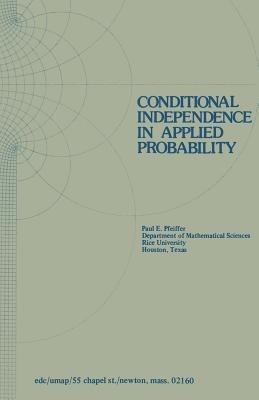
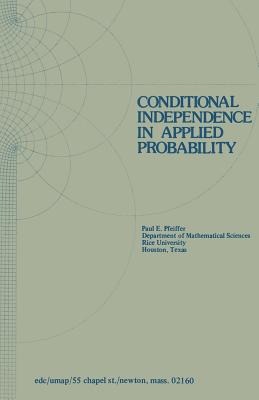
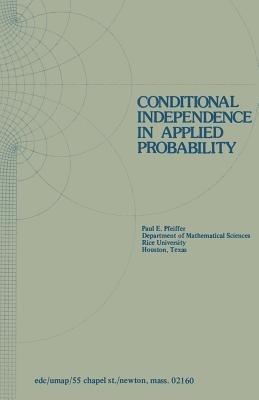
Conditional Independence in Applied Probability

68,50 €
+690
punti 
Venditore: Feltrinelli
Articolo acquistabile con Carta del Docente

Articolo acquistabile con Carta Cultura Giovani e Carta del Merito

Articolo acquistabile con Carta della Cultura

Paga con Klarna in 3 rate senza interessi per ordini superiori a 39 €

Dati e Statistiche
 Salvato in 0 liste dei desideri
Salvato in 0 liste dei desideri
Conditional Independence in Applied Probability
Disponibilità in 2 settimane
68,50 €
68,50 €
Disponibilità in 2 settimane


It would be difficult to overestimate the importance of stochastic independence in both the theoretical development and the practical appli cations of mathematical probability. The concept is grounded in the idea that one event does not "condition" another, in the sense that occurrence of one does not affect the likelihood of the occurrence of the other. This leads to a formulation of the independence condition in terms of a simple "product rule," which is amazingly successful in capturing the essential ideas of independence. However, there are many patterns of "conditioning" encountered in practice which give rise to quasi independence conditions. Explicit and precise incorporation of these into the theory is needed in order to make the most effective use of probability as a model for behavioral and physical systems. We examine two concepts of conditional independence. The first concept is quite simple, utilizing very elementary aspects of probability theory. Only algebraic operations are required to obtain quite important and useful new results, and to clear up many ambiguities and obscurities in the literature.
-
Autore:
-
Editore:
-
Collana:Modules and Monographs in Undergraduate Mathematics and Its Applications
-
Anno:2011
-
Rilegatura:Paperback / softback
Pagine:
158 p.
Testo in English
Dimensioni:
216 x 140 mm
EAN:
9781461263371

Informazioni e Contatti sulla Sicurezza dei Prodotti
Le schede prodotto sono aggiornate in conformità al Regolamento UE 988/2023. Laddove ci fossero taluni dati non disponibili per ragioni indipendenti da Feltrinelli, vi informiamo che stiamo compiendo ogni ragionevole sforzo per inserirli. Vi invitiamo a controllare periodicamente il sito www.lafeltrinelli.it per eventuali novità e aggiornamenti.
Per le vendite di prodotti da terze parti, ciascun venditore si assume la piena e diretta responsabilità per la commercializzazione del prodotto e per la sua conformità al Regolamento UE 988/2023, nonché alle normative nazionali ed europee vigenti.
Per informazioni sulla sicurezza dei prodotti, contattare productsafety@feltrinelli.it
