










AUDIOLIBRO IN LINGUA STRANIERA





Einstein’s Dice and Schrödinger’s Cat

19,71 €
+200
punti 
Venditore: Feltrinelli

Acquista online
Disponibile su APP ed eReader Kobo
Articolo acquistabile con Carta del Docente

Articolo acquistabile con Carta Cultura Giovani e Carta del Merito

Articolo acquistabile con Carta della Cultura

Dati e Statistiche
 Salvato in 0 liste dei desideri
Salvato in 0 liste dei desideri
Einstein’s Dice and Schrödinger’s Cat
Disponibile su APP ed eReader Kobo
19,71 €
19,71 €
Disponibile su APP ed eReader Kobo

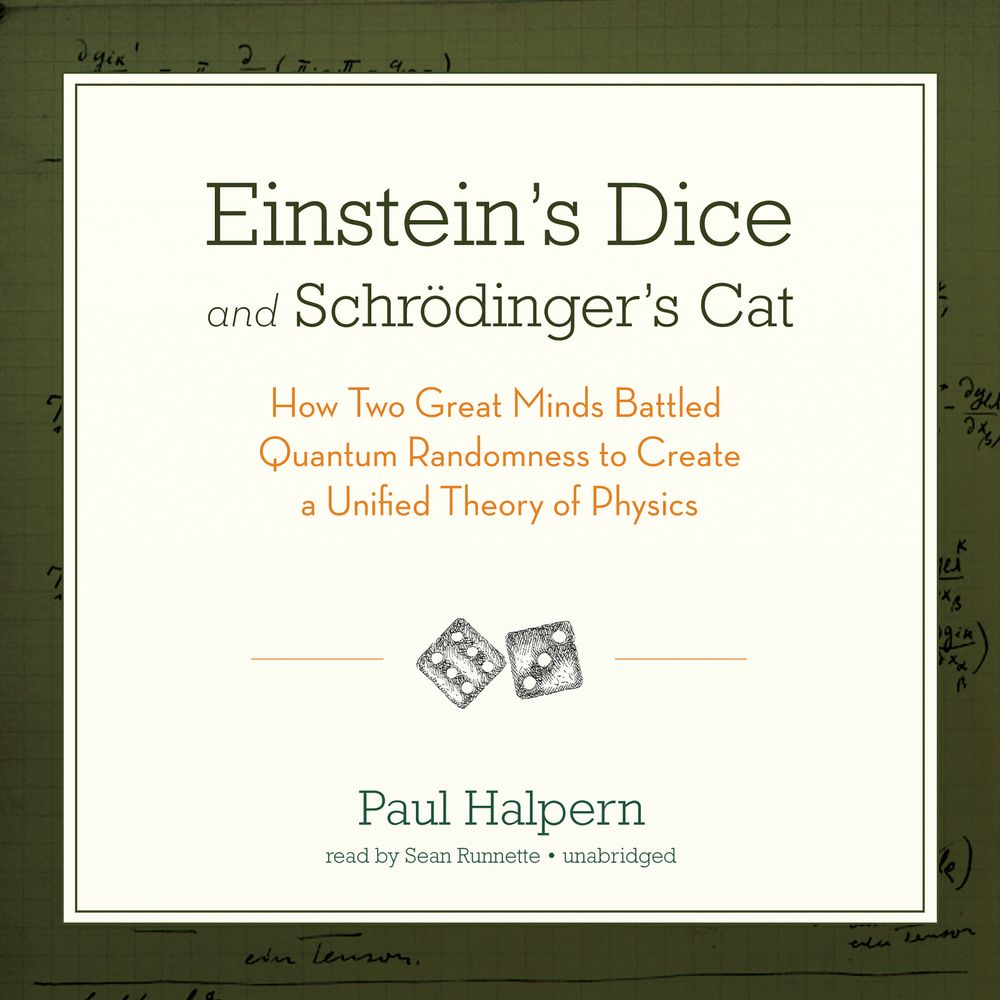


Albert Einstein and Erwin Schrödinger were friends and comrades-in-arms against what they considered the most preposterous aspects of quantum physics: its indeterminacy. Einstein famously quipped that God does not play dice with the universe, and Schrödinger is equally well known for his thought experiment about the cat in the box who ends up "spread out" in a probabilistic state, neither wholly alive nor wholly dead. Both of these famous images arose from these two men's dissatisfaction with quantum weirdness and with their assertion that underneath it all, there must be some essentially deterministic world. Even though it was Einstein's own theories that made quantum mechanics possible, both he and Schrödinger could not bear the idea that the universe was, at its most fundamental level, random. As the Second World War raged, both men struggled to produce a theory that would describe in full the universe's ultimate design, first as collaborators, then as competitors. They both ultimately failed in their search for a Grand Unified Theory—not only because quantum mechanics is true but because Einstein and Schrödinger were also missing a key component: of the four forces we recognize today (gravity, electromagnetism, the weak force, and the strong force), only gravity and electromagnetism were known at the time. Despite their failures, much of modern physics remains focused on the search for a Grand Unified Theory. As Halpern explains, the recent discovery of the Higgs boson makes the Standard Model—the closest thing we have to a unified theory—nearly complete. And while Einstein and Schrödinger tried and failed to explain everything in the cosmos through pure geometry, the development of string theory has, in its own quantum way, brought this idea back into vogue. As in so many things, even when he was wrong, Einstein couldn't help but be right.
-
Autore:
-
Narratore:
-
Durata in (hh:mm:ss):10:18:00
-
Anno edizione:2015

Formato:
Gli Audiolibri venduti dal nostro sito sono in formato MP3 e protetti da un DRM proprietario Kobo.
Compatibilità:
Gli Audiolibri venduti dal nostro sito possono essere ascoltati sul tuo smartphone o tablet tramite la APP gratuita Kobo Books scaricabile da iOS o Android. Gli Audiolibri non possono essere scaricati in locale o trasferiti su un client di ascolto diverso da quello fornito tramite Kobo. Non è possibile ascoltare gli audiolibri con la Kobo APP Desktop. Puoi ascoltare gli Audiolibri tramite determinati eReader Kobo, utilizzando cuffie o casse con Bluetooth. Visita la pagina degli eReader per avere maggiori dettagli.
Cloud:
Gli Audiolibri venduti singolarmente dal nostro sito sono immediatamente sincronizzati sul tuo account personale in automatico. Successivamente all'acquisto, sono subito disponibili all'ascolto tramite i client di lettura Kobo compatibili.
Clicca qui servissero ulteriori informazioni
