















Dati e Statistiche
 Salvato in 0 liste dei desideri
Salvato in 0 liste dei desideri
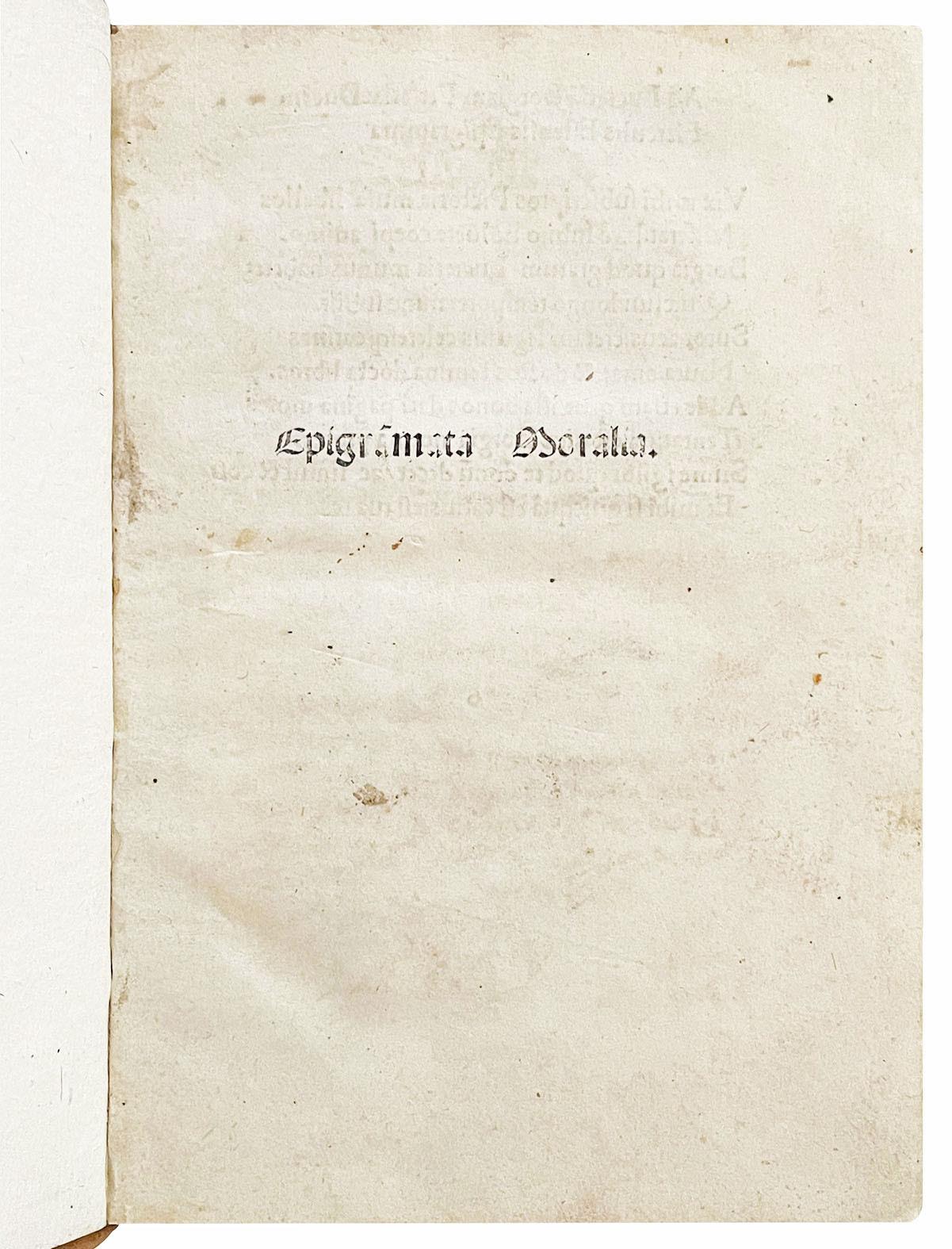
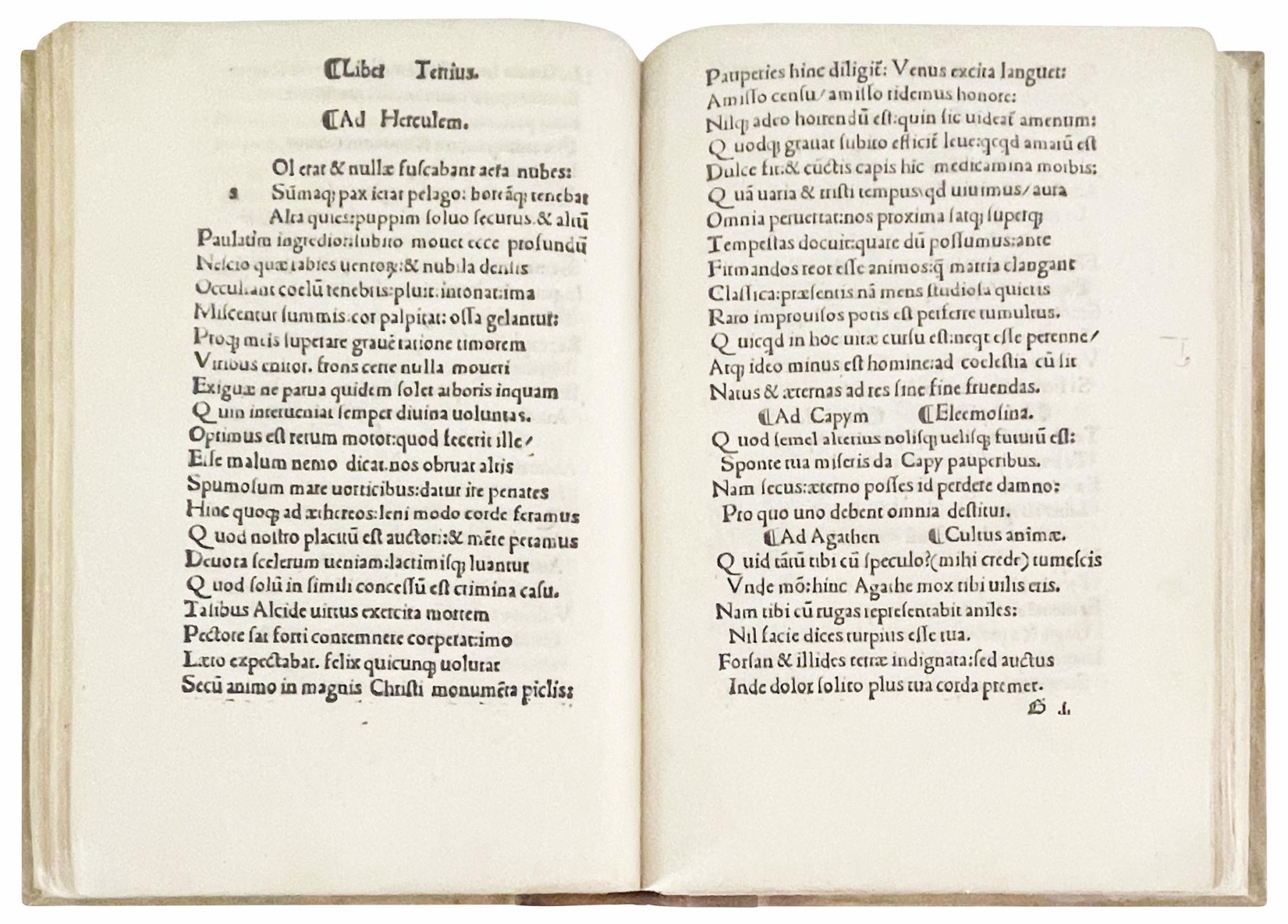
Epigrammata moralia
Disponibilità immediata
3.800,00 €
3.800,00 €
Disponibilità immediata



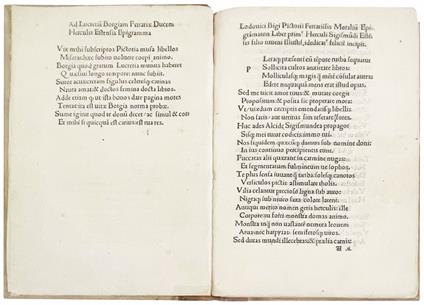
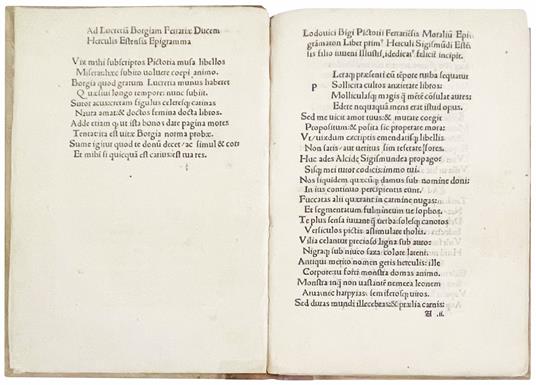
4to (205x147 mm). [98] leaves. Collation: A-L8 M10. Large printer's device printed on black ground at last leaf recto. 18th-century quarter mottled calf gilt, panel covered in parchment with painted coat-of-arms pasted in the center within an elaborate gilt frame, marbled pastedowns (slightly rubbed). 18th-century engraved armorial bookplate on the front pastedown. Some pale occasional staining, a clean copy with good margins.
Rare first edition of Lodovico Pittorio's four books of moralizing classical epigrams, dedicated by him to Ercole d'Este's son Alfonso I, who in 1501 married Lucrezia Borgia and in 1505, upon his father's death, became duke of Ferrara. On the verso of the title is an epigram by Ercole d'Este to his daughter-in-law Lucrezia Borgia.
Originally from Ferrara, Pittorio was a poet, humanist, and a leading intellectual in the Este court. He was a pupil of Battista Guarini and was on friendly terms with Giovanni Pico della Mirandola, Pellegrino Prisciani, Matteo Maria Boiardo, Alberto Pio, Ercole Strozzi, Antonio Tebaldeo, and especially Giovanni Francesco Pico, of whom he became the tutor. Pittorio also collaborated with the painter Cosmè Tura on the famous Roverella Altarpiece: his are the Latin verses inscribed on the wooden base of the instrument at the bottom of the painting played by the two angels, verses that were later included in his poem collection Carmina tumultuaria printed in Modena in 1492 (cf. J. Manca, Cosmè Tura: The Life and Art of a Painter in Estense Ferrara, Oxford, 2000, p. 114).
In his youth, Pittorio was an author of licentious verses that he later repudiated under the influence of his pupil G.F. Pico. Pittorio then devoted himself to works of a more philosophical and devotional inclination. He wrote homilies and sermons and translated biblical psalms into the vernacular. In 1516, he published the Hippolyta Epigrammaton per dialogos opus libri sex and in 1520 the poem Gorricia (cf. S. Pasquazi, ed., Poeti estensi del Rinascimento, Florence, 1966, pp. XXXII-XLII; see also G. Andenna, Pittorio, Ludovico, in: “Dizionario Biografico degli Italiani”, vol. 84, Rome, 2015, s.v.).
Edit 16, CNCE40210; USTC, 849040.
Venditore:
Libreria Alberto Govi
Vedi tutti i prodotti
Informazioni:
<p>4to (205x147 mm). [98] leaves. Collation: A-L<sup>8</sup> M<sup>10</sup>. Large printer's device printed on black ground at last leaf recto. 18<sup>th</sup>-century quarter mottled calf gilt, panel covered in parchment with painted coat-of-arms pasted in the center within an elaborate gilt frame, marbled pastedowns (slightly rubbed). 18<sup>th</sup>-century engraved armorial bookplate on the front pastedown. Some pale occasional staining, a clean copy with good margins.</p> <p>Rare first edition of Lodovico Pittorio's four books of moralizing classical epigrams, dedicated by him to Ercole d'Este's son Alfonso I, who in 1501 married Lucrezia Borgia and in 1505, upon his father's death, became duke of Ferrara. On the verso of the title is an epigram by Ercole d'Este to his daughter-in-law Lucrezia Borgia.</p> <p>Originally from Ferrara, Pittorio was a poet, humanist, and a leading intellectual in the Este court. He was a pupil of Battista Guarini and was on friendly terms with Giovanni Pico della Mirandola, Pellegrino Prisciani, Matteo Maria Boiardo, Alberto Pio, Ercole Strozzi, Antonio Tebaldeo, and especially Giovanni Francesco Pico, of whom he became the tutor. Pittorio also collaborated with the painter Cosm&egrave; Tura on the famous Roverella Altarpiece: his are the Latin verses inscribed on the wooden base of the instrument at the bottom of the painting played by the two angels, verses that were later included in his poem collection <em>Carmina tumultuaria</em> printed in Modena in 1492 (cf. J. Manca, <em>Cosm&egrave; Tura: The Life and Art of a Painter in Estense Ferrara</em>, Oxford, 2000, p. 114).</p> <p>In his youth, Pittorio was an author of licentious verses that he later repudiated under the influence of his pupil G.F. Pico. Pittorio then devoted himself to works of a more philosophical and devotional inclination. He wrote homilies
Immagini:


-
Editore:
-
Tipologia:
- Prodotto usato
- Condizioni: Usato - In buone condizioni
EAN:
2570270142819

Informazioni e Contatti sulla Sicurezza dei Prodotti
Le schede prodotto sono aggiornate in conformità al Regolamento UE 988/2023. Laddove ci fossero taluni dati non disponibili per ragioni indipendenti da Feltrinelli, vi informiamo che stiamo compiendo ogni ragionevole sforzo per inserirli. Vi invitiamo a controllare periodicamente il sito www.lafeltrinelli.it per eventuali novità e aggiornamenti.
Per le vendite di prodotti da terze parti, ciascun venditore si assume la piena e diretta responsabilità per la commercializzazione del prodotto e per la sua conformità al Regolamento UE 988/2023, nonché alle normative nazionali ed europee vigenti.
Per informazioni sulla sicurezza dei prodotti, contattare productsafety@feltrinelli.it
