










EBOOK IN LINGUA STRANIERA





Filming History from Below

21,41 €
+210
punti 
Venditore: Feltrinelli

Acquista online
Scaricabile subito
Articolo acquistabile con Carta del Docente

Articolo acquistabile con Carta Cultura Giovani e Carta del Merito

Dati e Statistiche
 Salvato in 0 liste dei desideri
Salvato in 0 liste dei desideri
Filming History from Below
Scaricabile subito
21,41 €
21,41 €
Scaricabile subito




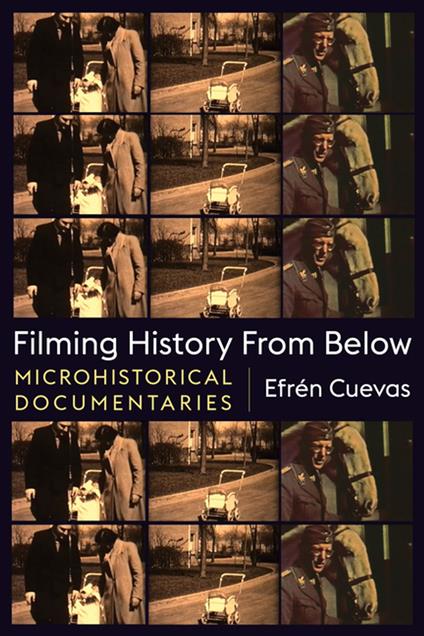
Traditional historical documentaries strive to project a sense of objectivity, producing a top-down view of history that focuses on public events and personalities. In recent decades, in line with historiographical trends advocating “history from below,” a different type of historical documentary has emerged, focusing on tightly circumscribed subjects, personal archives, and first-person perspectives. Efrén Cuevas categorizes these films as “microhistorical documentaries” and examines how they push cinema’s capacity as a producer of historical knowledge in new directions. Cuevas pinpoints the key features of these documentaries, identifying their parallels with written microhistory: a reduced scale of observation, a central role given to human agency, a conjectural approach to the use of archival sources, and a reliance on narrative structures. Microhistorical documentaries also use tools specific to film to underscore the affective dimension of historical narratives, often incorporating autobiographical and essayistic perspectives, and highlighting the role of the protagonists’ personal memories in the reconstruction of the past. These films generally draw from family archives, with an emphasis on snapshots and home movies. Filming History from Below examines works including Péter Forgács’s films dealing with the Holocaust such as The Maelstrom and Free Fall; documentaries about the Israeli-Palestinian conflict; Rithy Panh’s work on the Cambodian genocide; films about the internment of Japanese Americans during the Second World War such as A Family Gathering and History and Memory; and Jonas Mekas’s chronicle of migration in his diary film Lost, Lost, Lost.
-
Autore:
-
Anno edizione:2021
-
Editore:
-
Formato:
-
Lingua:Inglese
Compatibilità:
Tutti i dispositivi (eccetto Kindle) Scopri di più
Layout:
Reflowable
EAN:
9780231551571
Formato:
Gli eBook venduti da Feltrinelli.it sono in formato ePub e possono essere protetti da Adobe DRM. In caso di download di un file protetto da DRM si otterrà un file in formato .acs, (Adobe Content Server Message), che dovrà essere aperto tramite Adobe Digital Editions e autorizzato tramite un account Adobe, prima di poter essere letto su pc o trasferito su dispositivi compatibili.
Cloud:
Gli eBook venduti da Feltrinelli.it sono sincronizzati automaticamente su tutti i client di lettura Kobo successivamente all’acquisto. Grazie al Cloud Kobo i progressi di lettura, le note, le evidenziazioni vengono salvati e sincronizzati automaticamente su tutti i dispositivi e le APP di lettura Kobo utilizzati per la lettura.
Clicca qui per sapere come scaricare gli ebook utilizzando un pc con sistema operativo Windows
