










EBOOK IN LINGUA STRANIERA





Fire on Both Sides

9,99 €
+100
punti 
Venditore: Feltrinelli

Acquista online
Scaricabile subito
Articolo acquistabile con Carta del Docente

Articolo acquistabile con Carta Cultura Giovani e Carta del Merito

Articolo acquistabile con Carta della Cultura

Dati e Statistiche
 Salvato in 0 liste dei desideri
Salvato in 0 liste dei desideri
Fire on Both Sides
Scaricabile subito
9,99 €
9,99 €
Scaricabile subito

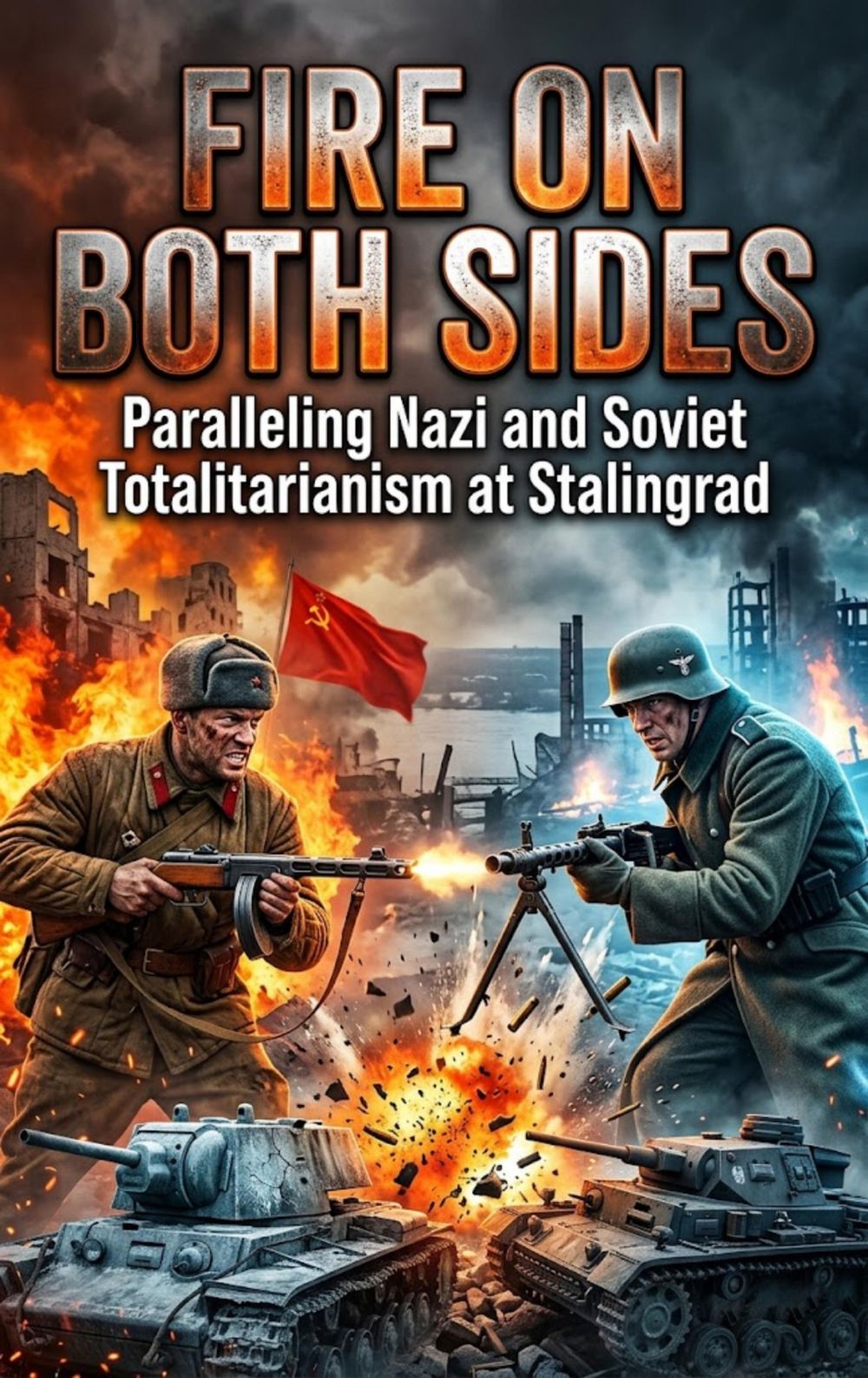


Stalingrad was not merely a battle — it was a collision of two totalitarian systems that shared more than either side would ever admit. Hitler ordered the annihilation of the city's population, declaring its civilians "thoroughly communistic" and deserving of death or deportation. Stalin, on the other side of the same rubble, refused to evacuate those same civilians, calculating that soldiers fight harder when ordinary lives are present to defend. Both men used human beings as instruments of ideological will, and both condemned hundreds of thousands to die in the service of a name — the name of a city, the name of a dictator, the name of a cause. Scholars have long noted the structural mirror between Hitler and Stalin: Hitler's subordinates feared failure; Stalin's feared survival. Hitler became increasingly alienated from his generals as the battle turned, refusing tactical retreats on ideological grounds; Stalin, driven by paranoia of equal ferocity, had already decimated his officer corps in the purges of the 1930s, and yet slowly — and unlike Hitler — began learning to trust military judgment as the war progressed. The battle thus became a study not only in military strategy but in the pathology of absolute power, where the same mistakes were made on both sides of the Volga for entirely different ideological reasons. For the soldiers buried in its ruins and the civilians who endured what followed, Stalingrad was a place where two systems competed not to liberate but to dominate. German forces drove tens of thousands of Stalingraders westward on foot into camps with no provisions, while Soviet authorities suppressed "evacuation moods" as defeatism, trapping their own people in a burning city. Between the Nazi Einsatzgruppen orders and the NKVD's lists of enemies of the people, the ordinary human being at Stalingrad had no ideology — only the desperate arithmetic of staying alive.
-
Autore:
-
Anno edizione:2026
-
Editore:
-
Formato:
-
Lingua:Inglese
Compatibilità:
Tutti i dispositivi (eccetto Kindle) Scopri di più
Layout:
Reflowable
EAN:
9783565410118

Formato:
Gli eBook venduti da Feltrinelli.it sono in formato ePub e possono essere protetti da Adobe DRM. In caso di download di un file protetto da DRM si otterrà un file in formato .acs, (Adobe Content Server Message), che dovrà essere aperto tramite Adobe Digital Editions e autorizzato tramite un account Adobe, prima di poter essere letto su pc o trasferito su dispositivi compatibili.
Cloud:
Gli eBook venduti da Feltrinelli.it sono sincronizzati automaticamente su tutti i client di lettura Kobo successivamente all’acquisto. Grazie al Cloud Kobo i progressi di lettura, le note, le evidenziazioni vengono salvati e sincronizzati automaticamente su tutti i dispositivi e le APP di lettura Kobo utilizzati per la lettura.
Clicca qui per sapere come scaricare gli ebook utilizzando un pc con sistema operativo Windows
