










EBOOK IN LINGUA STRANIERA





Linux Systems Architecture in the AI Era: Engineering the Linux Operating System from Filesystem and Kernel Fundamentals to Cloud Infrastructure

8,49 €
+80
punti 
Venditore: Feltrinelli

Acquista online
Scaricabile subito
Articolo acquistabile con Carta del Docente

Articolo acquistabile con Carta Cultura Giovani e Carta del Merito

Articolo acquistabile con Carta della Cultura

Abbonati a Kobo plus per avere accesso illimitato a questo contenuto

Dati e Statistiche
 Salvato in 0 liste dei desideri
Salvato in 0 liste dei desideri
Linux Systems Architecture in the AI Era: Engineering the Linux Operating System from Filesystem and Kernel Fundamentals to Cloud Infrastructure
Scaricabile subito
8,49 €
8,49 €
Scaricabile subito

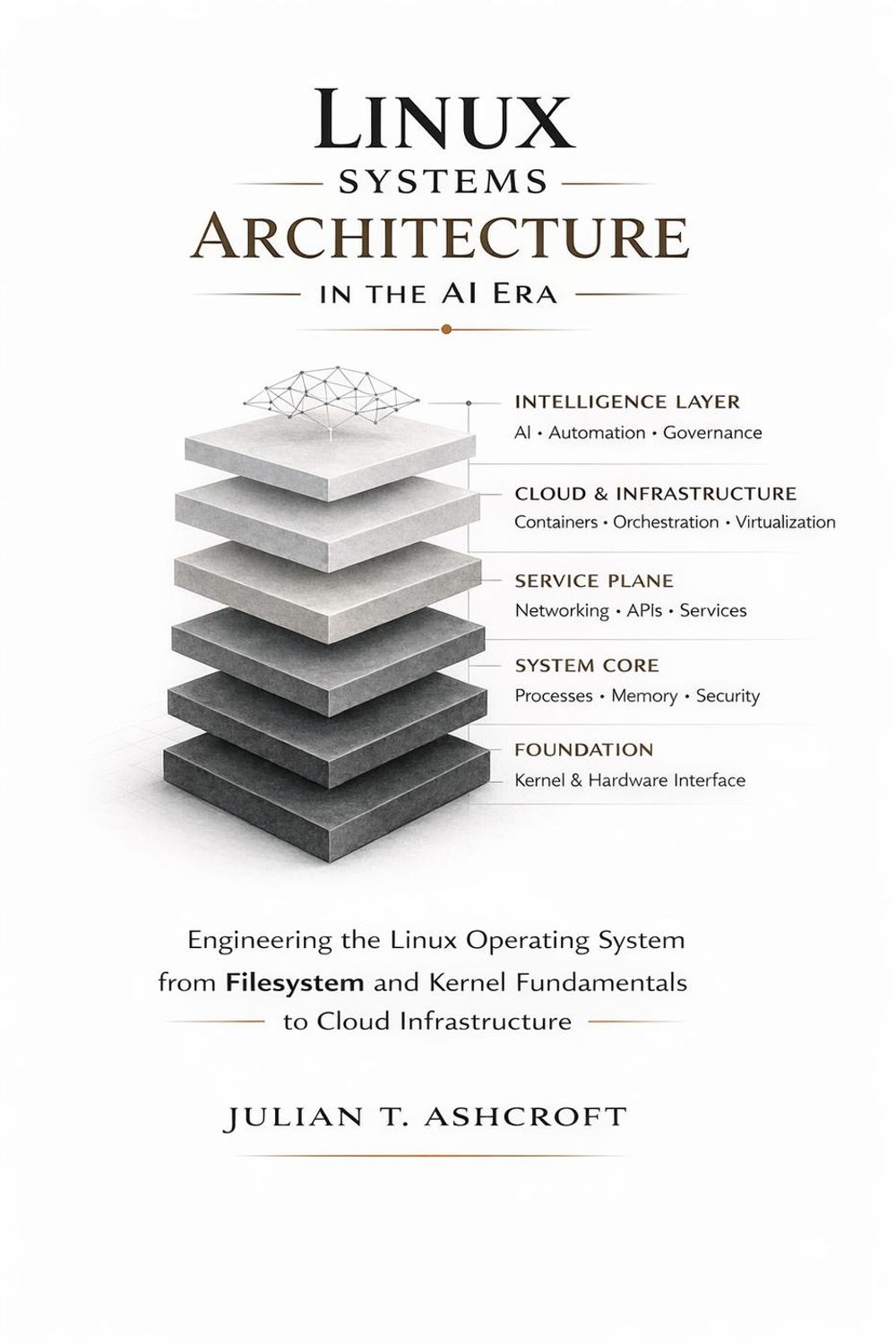



Linux is not a collection of commands. It is an architectural substrate. Modern infrastructure — containers, cloud platforms, orchestration systems, distributed databases, and AI workloads — ultimately depends on kernel primitives defined decades ago. Yet most engineers interact with Linux at the surface level, without fully understanding the structural mechanisms that govern reliability, isolation, performance, and security. Linux Systems Architecture in the AI Era is not a certification guide or command reference. It is a systems-level examination of Linux as engineered infrastructure. This book moves deliberately from fundamentals to production-scale realities: Kernel responsibilities and boundary enforcement Process scheduling, memory management, and I/O behavior Filesystem hierarchy, storage integrity, and reliability trade-offs Permissions, privilege models, and operational trust Networking architecture and failure diagnostics Containers, namespaces, and control groups beneath orchestration layers Mutable vs. immutable infrastructure strategies Observability, monitoring, and structured troubleshooting AI-assisted diagnostics, bounded automation, and governance frameworks Rather than focusing on distribution-specific instructions, this book builds architectural literacy — the ability to reason about Linux as a layered system. It examines failure modes, trade-offs, and resource arbitration under real production pressure. In the AI era, automation and intelligent tooling amplify both capability and risk. This book treats AI not as a replacement for systems understanding, but as an operational accelerator that must be bounded by discipline, auditability, and structural awareness. Written for: Platform engineers Site reliability engineers DevOps practitioners Systems architects Technical leads and CTOs Engineers responsible for production infrastructure If Linux continues to define the boundary between hardware and abstraction — and it does — then understanding its architecture is not optional. It is foundational. This book does not teach you how to use Linux. It teaches you how Linux works — and how to design responsibly on top of it.
-
Autore:
-
Anno edizione:2026
-
Editore:
-
Formato:
-
Lingua:Inglese
Compatibilità:
Tutti i dispositivi (eccetto Kindle) Scopri di più
Layout:
Reflowable
EAN:
9798233749087

Formato:
Gli eBook venduti da Feltrinelli.it sono in formato ePub e possono essere protetti da Adobe DRM. In caso di download di un file protetto da DRM si otterrà un file in formato .acs, (Adobe Content Server Message), che dovrà essere aperto tramite Adobe Digital Editions e autorizzato tramite un account Adobe, prima di poter essere letto su pc o trasferito su dispositivi compatibili.
Cloud:
Gli eBook venduti da Feltrinelli.it sono sincronizzati automaticamente su tutti i client di lettura Kobo successivamente all’acquisto. Grazie al Cloud Kobo i progressi di lettura, le note, le evidenziazioni vengono salvati e sincronizzati automaticamente su tutti i dispositivi e le APP di lettura Kobo utilizzati per la lettura.
Clicca qui per sapere come scaricare gli ebook utilizzando un pc con sistema operativo Windows
