









EBOOK IN LINGUA STRANIERA





Machine Unlearning for Governance of Foundation Models

37,43 €
+370
punti 
Venditore: Feltrinelli

Acquista online
Scaricabile subito
Articolo acquistabile con Carta del Docente

Articolo acquistabile con Carta Cultura Giovani e Carta del Merito

Articolo acquistabile con Carta della Cultura

Dati e Statistiche
 Salvato in 0 liste dei desideri
Salvato in 0 liste dei desideri
Machine Unlearning for Governance of Foundation Models
Scaricabile subito
37,43 €
37,43 €
Scaricabile subito
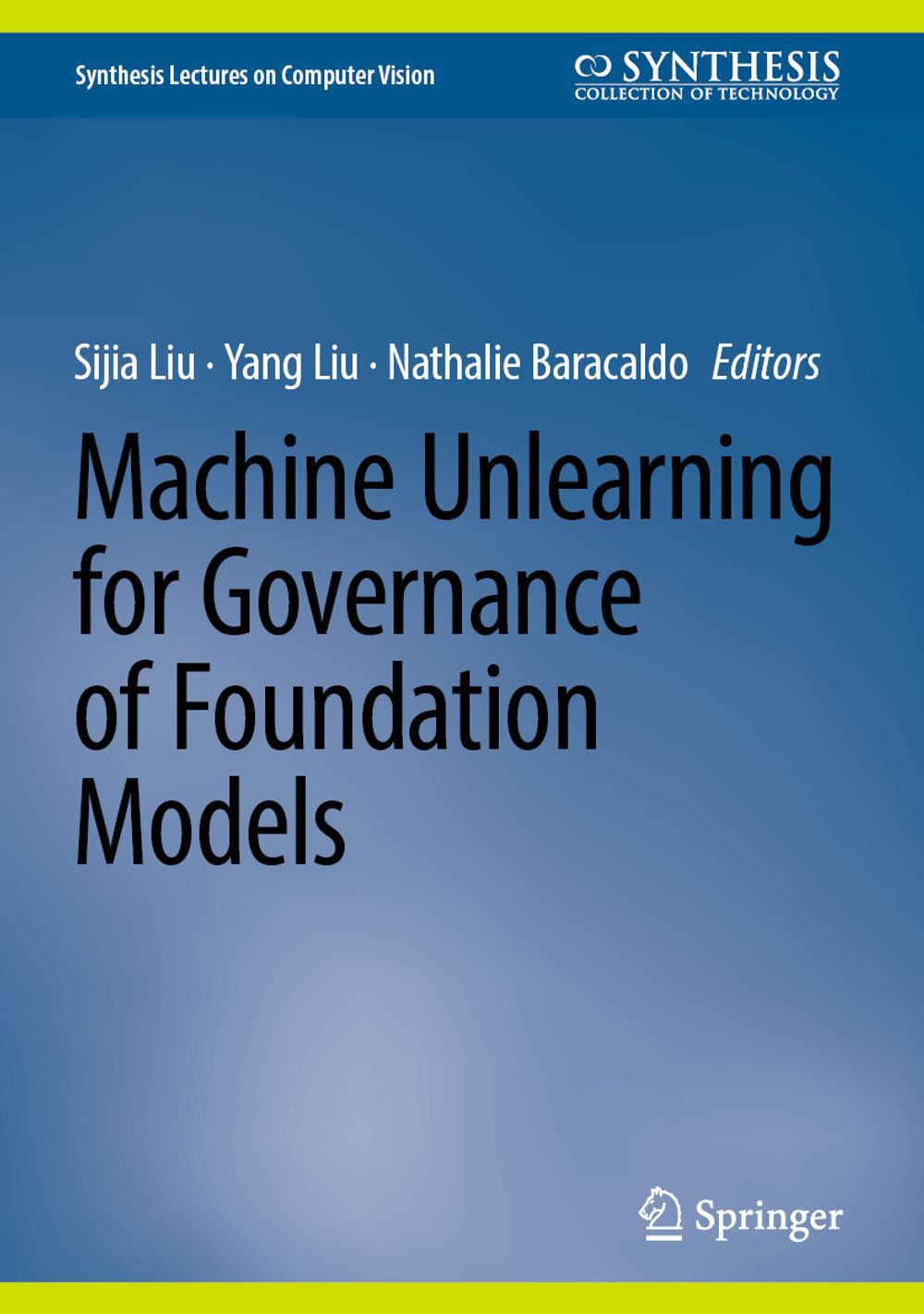


This book provides a systematic and in-depth introduction to machine unlearning (MU) for foundation models, framed through an optimization–model–data tri-design perspective and complemented by assessments and applications. As foundation models are continuously adapted and reused, the ability to selectively remove unwanted data, knowledge, or model behavior, without full retraining, poses new theoretical and practical challenges. Thus, MU has become a critical capability for trustworthy, deployable, and regulation-ready artificial intelligence. From the optimization viewpoint, this book treats unlearning as a multi-objective and often adversarial problem that must simultaneously enforce targeted forgetting, preserve model utility, resist recovery attacks, and remain computationally efficient. From the model perspective, the book examines how knowledge is distributed across layers and latent subspaces, motivating modular and localized unlearning. From the data perspective, the book explores forget-set construction, data attribution, corruption, and coresets as key drivers of reliable forgetting. Bridging theory and practice, the book also provides a comprehensive review of benchmark datasets and evaluation metrics for machine unlearning, critically examining their strengths and limitations. The authors further survey a wide range of applications in computer vision and large language models, including AI safety, privacy, fairness, and industrial deployment, highlighting why post-training model modification is often preferred over repeated retraining in real-world systems. By unifying optimization, model, data, evaluation, and application perspectives, this book offers both a foundational framework and a practical toolkit for designing machine unlearning methods that are effective, robust, and ready for large-scale, regulated deployment.
-
Curatore:
-
Anno edizione:2026
-
Editore:
-
Formato:
Lingua:
Inglese
Compatibilità:
Tutti i dispositivi (eccetto Kindle) Scopri di più
Layout:
Reflowable
EAN:
9783032172822

Formato:
Gli eBook venduti da Feltrinelli.it sono in formato ePub e possono essere protetti da Adobe DRM. In caso di download di un file protetto da DRM si otterrà un file in formato .acs, (Adobe Content Server Message), che dovrà essere aperto tramite Adobe Digital Editions e autorizzato tramite un account Adobe, prima di poter essere letto su pc o trasferito su dispositivi compatibili.
Cloud:
Gli eBook venduti da Feltrinelli.it sono sincronizzati automaticamente su tutti i client di lettura Kobo successivamente all’acquisto. Grazie al Cloud Kobo i progressi di lettura, le note, le evidenziazioni vengono salvati e sincronizzati automaticamente su tutti i dispositivi e le APP di lettura Kobo utilizzati per la lettura.
Clicca qui per sapere come scaricare gli ebook utilizzando un pc con sistema operativo Windows
