










LIBRO INGLESE





Participatory Redevelopment as Contested Arenas in China: Power Relations and Institutional Transformation

120,99 €
+1210
punti 
Venditore: Feltrinelli
Articolo acquistabile con Carta del Docente

Articolo acquistabile con Carta Cultura Giovani e Carta del Merito

Articolo acquistabile con Carta della Cultura

Paga con Klarna in 3 rate senza interessi per ordini superiori a 39 €

Dati e Statistiche
 Salvato in 0 liste dei desideri
Salvato in 0 liste dei desideri
Participatory Redevelopment as Contested Arenas in China: Power Relations and Institutional Transformation
Disponibilità in 3 settimane
120,99 €
120,99 €
Disponibilità in 3 settimane

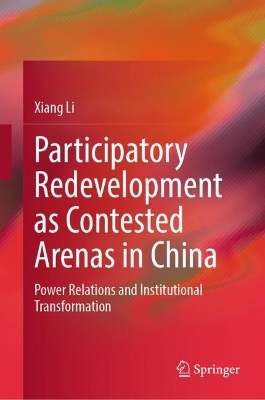



Why do participatory reforms in authoritarian settings so often recentre, rather than diffuse, power? And how do institutional rules and the distribution of resources channel participatory initiatives toward outcomes that ultimately reinforce state dominance? This book addresses these questions through an in-depth examination of participatory urban redevelopment in China. Traditional redevelopment institutions, long characterized by top-down state control and the exclusion of residents, generated widespread public resistance and social instability. In response, the Chinese state introduced participatory reforms that formally incorporated residents into decision-making processes, aiming to mitigate opposition to forced demolition, inadequate compensation, and escalating social tensions. While these reforms reshaped procedures and institutional mechanisms, their deeper effects on power relations remain poorly understood. Building on Giddens’ structuration theory, Foucault’s conception of power, and Ostrom’s Institutional Analysis and Development (IAD) framework, the book develops a power arena framework to examine how rules and resources structure interactions among stakeholders and shape the distribution of power in participatory urban redevelopment. The findings demonstrate that participatory reforms have indeed enabled individual property owners and strengthened community-level capacities to engage in decision-making, partially constraining local governmental authority. However, rather than producing a shift toward collaborative governance, these reforms frequently recentre power within the state. Through its control over key institutional rules and strategic resources, local government continues to orchestrate interactions among stakeholders and maintain a dominant position within a hierarchical power structure. By showing how participatory institutions in an authoritarian context can simultaneously empower social actors and reinforce state control, this book offers a novel explanation for the paradoxical outcomes of participation. It contributes to broader debates on power, participation, and urban governance by revealing why institutional reforms designed to diffuse authority often end up consolidating it—and why understanding the rules and resources that underpin participation is crucial to explaining this outcome.
-
Autore:
-
Editore:
-
Anno:2026
-
Rilegatura:Hardback
-
Pagine:225 p.
Testo in English
Dimensioni:
235 x 155 mm
EAN:
9789819593934

Informazioni e Contatti sulla Sicurezza dei Prodotti
Le schede prodotto sono aggiornate in conformità al Regolamento UE 988/2023. Laddove ci fossero taluni dati non disponibili per ragioni indipendenti da Feltrinelli, vi informiamo che stiamo compiendo ogni ragionevole sforzo per inserirli. Vi invitiamo a controllare periodicamente il sito www.lafeltrinelli.it per eventuali novità e aggiornamenti.
Per le vendite di prodotti da terze parti, ciascun venditore si assume la piena e diretta responsabilità per la commercializzazione del prodotto e per la sua conformità al Regolamento UE 988/2023, nonché alle normative nazionali ed europee vigenti.
Per informazioni sulla sicurezza dei prodotti, contattare productsafety@feltrinelli.it
