










EBOOK IN LINGUA STRANIERA





Propaganda Films for the Marshall Plan and Soviet Counter-Propaganda

13,99 €
+140
punti 
Venditore: Feltrinelli

Acquista online
Scaricabile subito
Articolo acquistabile con Carta del Docente

Articolo acquistabile con Carta Cultura Giovani e Carta del Merito

Articolo acquistabile con Carta della Cultura

Dati e Statistiche
 Salvato in 0 liste dei desideri
Salvato in 0 liste dei desideri
Propaganda Films for the Marshall Plan and Soviet Counter-Propaganda
Scaricabile subito
13,99 €
13,99 €
Scaricabile subito

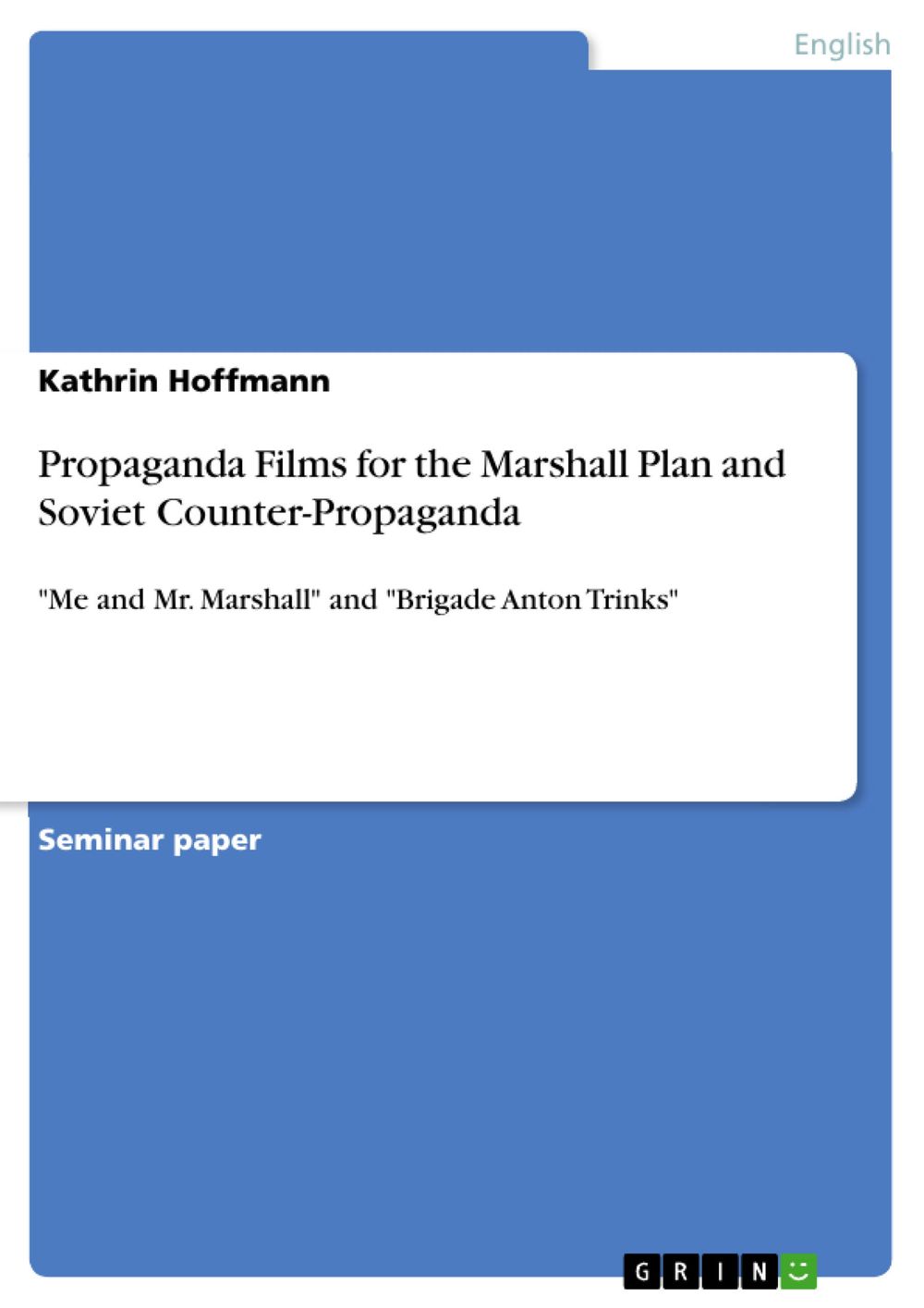



Seminar paper from the year 2012 in the subject American Studies - Culture and Applied Geography, grade: 1,7, Free University of Berlin, language: English, abstract: In the aftermath of WW II, Europe lay in ruins – cities were devastated, economies paralyzed, and the life of the population was ruled by hunger and poverty. To help Europe, the United States initiated the European Recovery Program (short ERP), commonly known under the name Marshall Plan. Named after the Secretary of State George C. Marshall, who had demanded technical and financial aid for Europe in an address at Harvard University in 1947, the plan focused on ‘help for self-help’, providing money and goods to support the reconstruction of Europe (cf. Berlin Film Festival 2004, 8). In 1953, Marshall received the Nobel Peace Prize for his actions (cf. BFF 2005, Kosslick 4). The plan was in operation for four years, starting in April 1948. During the Marshall Plan years, the aid program was advertised in a large-scale propaganda operation through posters, brochures, exhibitions, radio programs, and films (cf. BFF 2004, Rother 7). Documentary film units were put into place throughout Europe in order to promote the plan and instill hope in European people, but also to prevent the spread of communism from the Soviet Union. Over 300 short films were produced in total, ranging from films aimed at the re-education and re-orientation in the early post-war years to films propagating the Marshall Plan. In Germany, these films were shown both commercially and non-commercially, the latterby touring units with projectors at town squares, in cultural institutions, schools, or discussion clubs (cf. Schulberg 207 ff.). As a reaction to these movies, the German Democratic Republic produced counter-propaganda films to promote Soviet ideals. All of these films had been buried in archives, e.g., in the National Archive in Washington, D.C. or in the German Federal Archive-Film Archive(cf. BFF 2004, Kosslick 4). Consequently, the films had fallen into oblivion for decades until their re-screening began in 2004, following the initiative of Sandra Schulberg, daughter of Marshall Plan film producer Stuart Schulberg (cf. BFF 2004, Kosslick 4).The Berlin Film Festivals in the years 2004 through 2006 offered three film series under the titles “Selling Democracy: Films of the Marshall Plan, 1947-1955,” “Winning the Peace,” and “Friendly Persuasion.”
-
Autore:
-
Anno edizione:2014
-
Editore:
-
Formato:
-
Lingua:Inglese
Compatibilità:
Tutti i dispositivi (eccetto Kindle) Scopri di più
Layout:
Reflowable
EAN:
9783656618157

Formato:
Gli eBook venduti da Feltrinelli.it sono in formato ePub e possono essere protetti da Adobe DRM. In caso di download di un file protetto da DRM si otterrà un file in formato .acs, (Adobe Content Server Message), che dovrà essere aperto tramite Adobe Digital Editions e autorizzato tramite un account Adobe, prima di poter essere letto su pc o trasferito su dispositivi compatibili.
Cloud:
Gli eBook venduti da Feltrinelli.it sono sincronizzati automaticamente su tutti i client di lettura Kobo successivamente all’acquisto. Grazie al Cloud Kobo i progressi di lettura, le note, le evidenziazioni vengono salvati e sincronizzati automaticamente su tutti i dispositivi e le APP di lettura Kobo utilizzati per la lettura.
Clicca qui per sapere come scaricare gli ebook utilizzando un pc con sistema operativo Windows
