










LIBRO INGLESE





Completeness and Reduction in Algebraic Complexity Theory

137,60 €
+1380
punti 
Venditore: Feltrinelli
Articolo acquistabile con Carta del Docente

Articolo acquistabile con Carta Cultura Giovani e Carta del Merito

Articolo acquistabile con Carta della Cultura

Paga con Klarna in 3 rate senza interessi per ordini superiori a 39 €

Dati e Statistiche
 Salvato in 0 liste dei desideri
Salvato in 0 liste dei desideri
Completeness and Reduction in Algebraic Complexity Theory
Disponibilità in 2 settimane
137,60 €
137,60 €
Disponibilità in 2 settimane

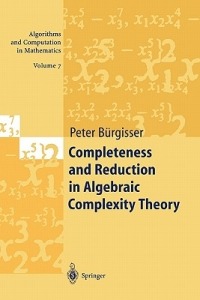



One of the most important and successful theories in computational complex ity is that of NP-completeness. This discrete theory is based on the Turing machine model and achieves a classification of discrete computational prob lems according to their algorithmic difficulty. Turing machines formalize al gorithms which operate on finite strings of symbols over a finite alphabet. By contrast, in algebraic models of computation, the basic computational step is an arithmetic operation (or comparison) of elements of a fixed field, for in stance of real numbers. Hereby one assumes exact arithmetic. In 1989, Blum, Shub, and Smale [12] combined existing algebraic models of computation with the concept of uniformity and developed a theory of NP-completeness over the reals (BSS-model). Their paper created a renewed interest in the field of algebraic complexity and initiated new research directions. The ultimate goal of the BSS-model (and its future extensions) is to unite classical dis crete complexity theory with numerical analysis and thus to provide a deeper foundation of scientific computation (cf. [11, 101]). Already ten years before the BSS-paper, Valiant [107, 110] had proposed an analogue of the theory of NP-completeness in an entirely algebraic frame work, in connection with his famous hardness result for the permanent [108]. While the part of his theory based on the Turing approach (#P-completeness) is now standard and well-known among the theoretical computer science com munity, his algebraic completeness result for the permanents received much less attention.
-
Autore:
-
Editore:
-
Collana:Algorithms and Computation in Mathematics
-
Anno:2010
-
Rilegatura:Paperback / softback
Pagine:
168 p.
Testo in English
Dimensioni:
235 x 155 mm
EAN:
9783642086045

Informazioni e Contatti sulla Sicurezza dei Prodotti
Le schede prodotto sono aggiornate in conformità al Regolamento UE 988/2023. Laddove ci fossero taluni dati non disponibili per ragioni indipendenti da Feltrinelli, vi informiamo che stiamo compiendo ogni ragionevole sforzo per inserirli. Vi invitiamo a controllare periodicamente il sito www.lafeltrinelli.it per eventuali novità e aggiornamenti.
Per le vendite di prodotti da terze parti, ciascun venditore si assume la piena e diretta responsabilità per la commercializzazione del prodotto e per la sua conformità al Regolamento UE 988/2023, nonché alle normative nazionali ed europee vigenti.
Per informazioni sulla sicurezza dei prodotti, contattare productsafety@feltrinelli.it
