









EBOOK IN LINGUA STRANIERA





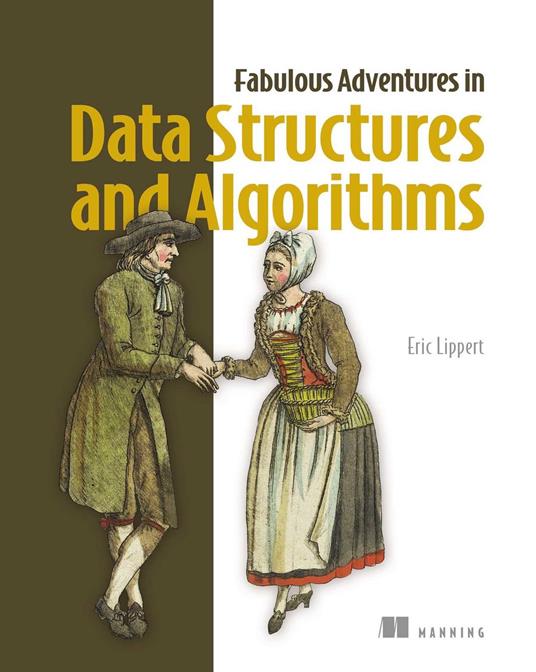
Fabulous Adventures in Data Structures and Algorithms

57,50 €
+580
punti 
Venditore: Feltrinelli
Articolo acquistabile con Carta del Docente

Articolo acquistabile con Carta Cultura Giovani e Carta del Merito

Articolo acquistabile con Carta della Cultura

Dati e Statistiche
 Salvato in 0 liste dei desideri
Salvato in 0 liste dei desideri
Fabulous Adventures in Data Structures and Algorithms
Disponibile dal 29 settembre 2026
57,50 €
57,50 €
Disponibile dal 29 settembre 2026
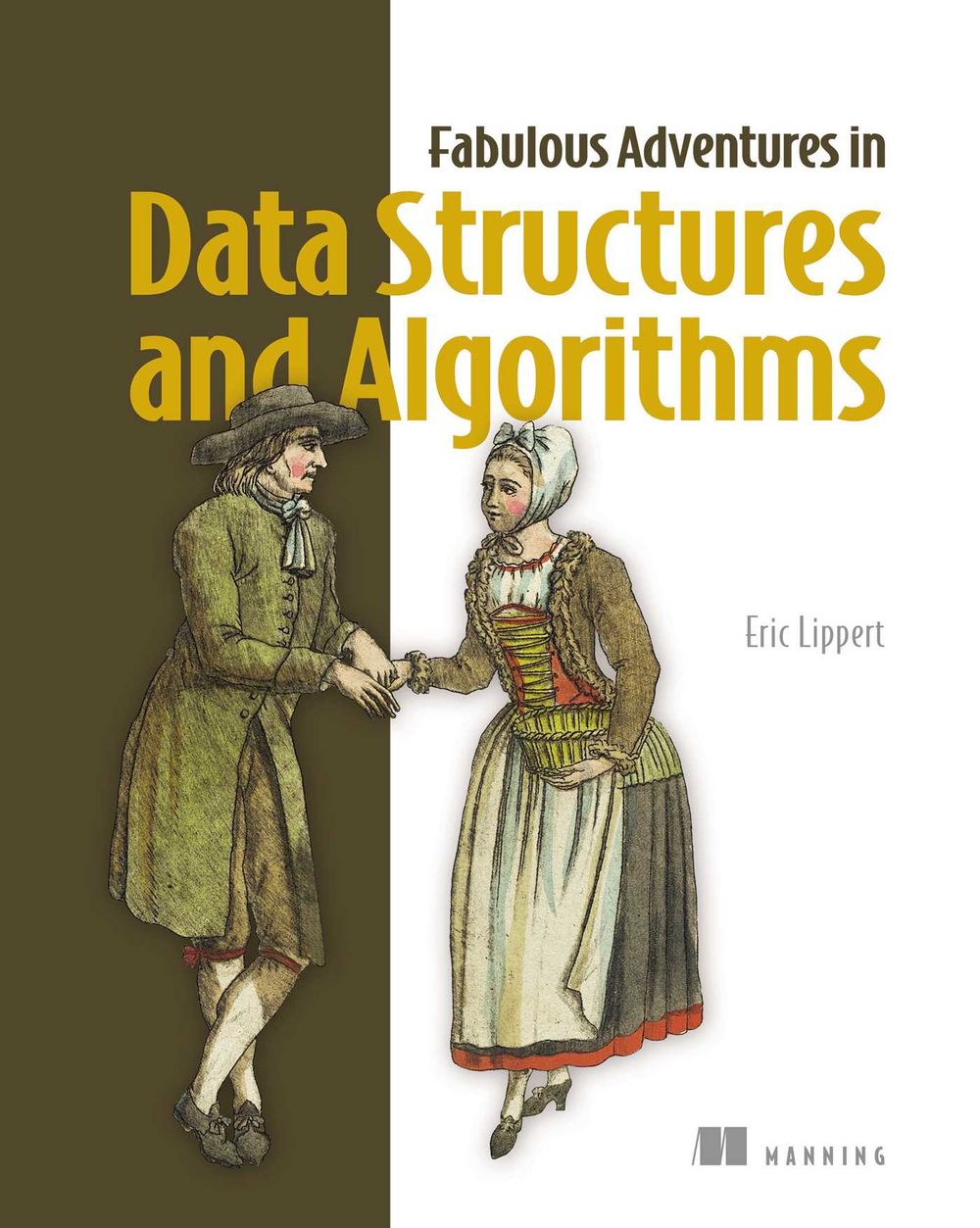


Get the eBook free when you register your print book at Manning. "Rigorous, curious, quietly funny, and extraordinarily generous with hard-won insight." —Scott Hanselman, Microsoft This book invites you to step off the beaten path and explore interesting, unfamiliar, and even exotic algorithms that will challenge your perspective and elevate your code. Legendary language designer Eric Lippert guides you with a refreshing, conversational approach, providing beautifully practical examples that highlight the recurring patterns behind stubborn coding problems. You’ll begin with a fresh look at foundational, thread-safe, and persistent immutable data structures. Lippert demystifies stacks, queues, and finger-tree deques, illustrating how to manage memory efficiently through persistence. For developers working in highly concurrent, cloud native environments, these patterns will help you eliminate hard-to-spot race conditions and state-mutation bugs. Your fabulous adventure then turns to structural search, compiler design, and the integration of functional programming within mainstream object-oriented languages. You’ll dive into Directed Acyclic Word Graphs (DAWGs), greedy pretty printers, and the complexities of tree unification. This section bridges theory and real-world tools, teaching you how to design highly modular compilers or robust static analysis engines and to write declarative, composable, and expressive APIs. In the final leg of your journey, you’ll model randomness, statistical reasoning, and continuous probability—core concepts for AI and predictive analytics. Lippert introduces advanced Bayesian and monadic techniques, teaching you how to construct joint distributions and sample them using the powerful Metropolis algorithm. This statistical toolkit aligns perfectly with modern data-driven systems that need to make consistent, sound decisions under real-world uncertainty. In the age of AI coding, implementation is becoming cheaper. AI can write code, but it cannot relieve developers of responsibility for understanding what the code means, why a given solution was chosen, how it will scale, and whether the problem has been framed correctly. This book develops exactly that judgment. It teaches the part that is becoming more valuable: recognizing, selecting, questioning, and evaluating the ideas behind implementations. It is an apprenticeship in computational taste, taught through unusual and memorable examples. What's inside • Build highly efficient, thread-safe concurrent systems using immutable parts • Compress massive data representation sizes using memoized quadtrees and DAWGs • Solve complex compiler optimizations using unification and backtracking search • Automate precise, mathematically sound decisions under real-world uncertainty About the reader For working programmers familiar with C#, Java, or Python. About the author Eric Lippert has designed programming languages, compilers, and developer tools for Microsoft, Coverity, and Facebook. He was a key member of the C# language design team and writes at ericlippert.com. Table of Contents 1 Starting a fabulous adventure Part 1 2 Immutable stacks and queues 3 An immutable deque 4 Memoizing immutable quadtrees to make a better Life 5 What’s up with you, Directed Acyclic Word Graph? 6 Combinatorial algorithms 7 First abstract nonsense interlude: Category theory Part 2 8 Coloring graphs with backtracking search 9 Greedy iterative pretty printing 10 Unification and anti-unification 11 Second abstract nonsense interlude: Monads Part 3 12 A better abstraction for randomness 13 Conditional probability with Bayes’ theorem 14 Third abstract nonsense interlude: The probability monad 15 Sampling continuous distributions 16 Markov processes and the Metropolis algorithm A Notes on C# B Further reading
-
Autore:
-
Anno edizione:2026
-
Editore:
-
Lingua:Inglese

Formato:
Gli eBook venduti da Feltrinelli.it sono in formato ePub e possono essere protetti da Adobe DRM. In caso di download di un file protetto da DRM si otterrà un file in formato .acs, (Adobe Content Server Message), che dovrà essere aperto tramite Adobe Digital Editions e autorizzato tramite un account Adobe, prima di poter essere letto su pc o trasferito su dispositivi compatibili.
Cloud:
Gli eBook venduti da Feltrinelli.it sono sincronizzati automaticamente su tutti i client di lettura Kobo successivamente all’acquisto. Grazie al Cloud Kobo i progressi di lettura, le note, le evidenziazioni vengono salvati e sincronizzati automaticamente su tutti i dispositivi e le APP di lettura Kobo utilizzati per la lettura.
Clicca qui per sapere come scaricare gli ebook utilizzando un pc con sistema operativo Windows
