










EBOOK IN LINGUA STRANIERA





Geometry for Programmers

56,37 €
+560
punti 
Venditore: Feltrinelli

Acquista online
Scaricabile subito
Articolo acquistabile con Carta del Docente

Articolo acquistabile con Carta Cultura Giovani e Carta del Merito

Articolo acquistabile con Carta della Cultura

Dati e Statistiche
 Salvato in 0 liste dei desideri
Salvato in 0 liste dei desideri
Geometry for Programmers
Scaricabile subito
56,37 €
56,37 €
Scaricabile subito

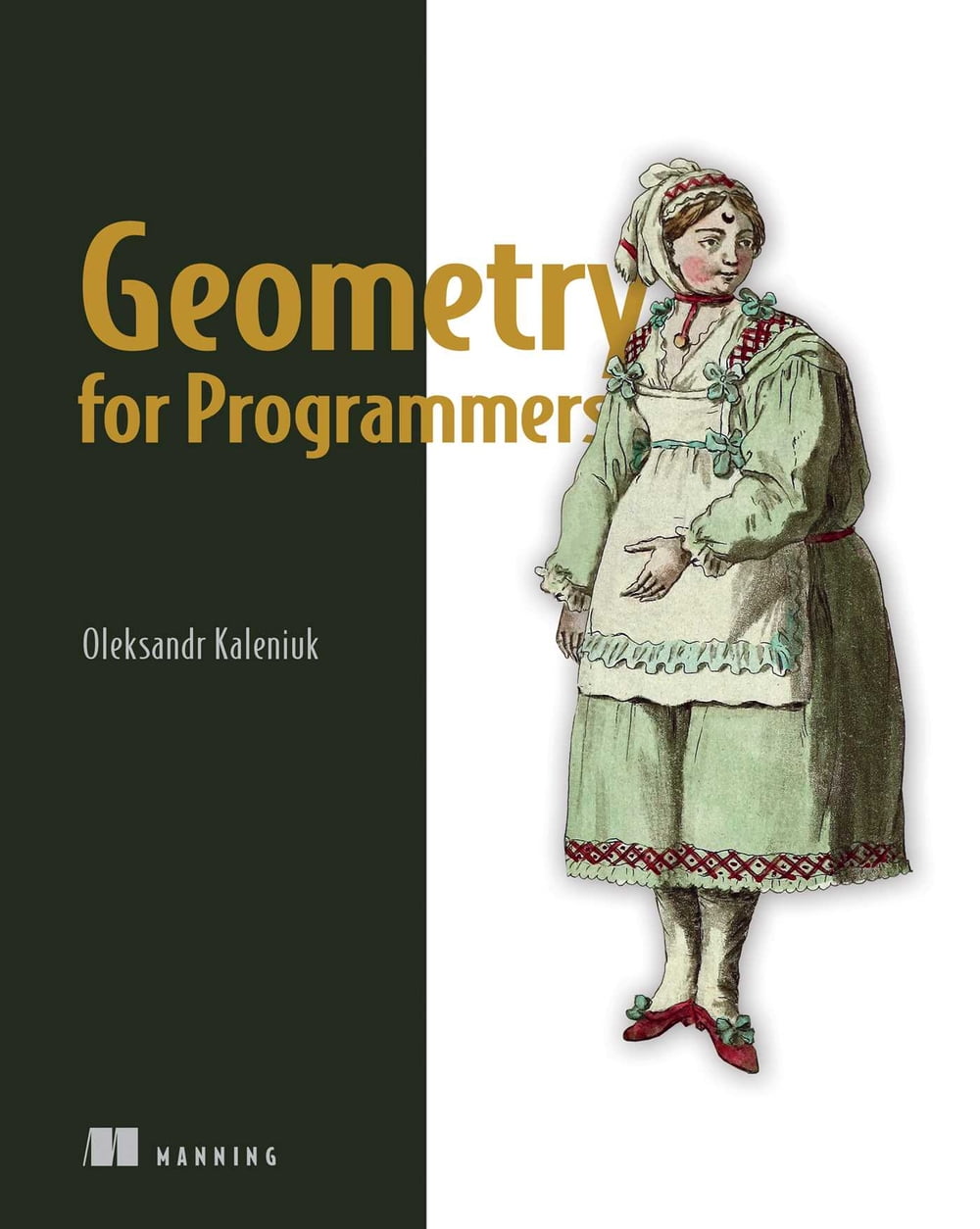



Master the math behind CAD, game engines, GIS, and more! This hands-on book teaches you the geometry used to create simulations, 3D prints, and other models of the physical world. In Geometry for Programmers you will learn how to: Speak the language of applied geometry Compose geometric transformations economically Craft custom splines for efficient curves and surface generation Pick and implement the right geometric transformations Confidently use important algorithms that operate on triangle meshes, distance functions, and voxels Geometry for Programmers guides you through the math behind graphics and modeling tools. It’s full of practical examples and clear explanations that make sense even if you don’t have a background in advanced math. You’ll learn how basic geometry can help you avoid code layering and repetition, and even how to drive down cloud hosting costs with more efficient runtimes. Cheerful language, charts, illustrations, equations, and Python code help make geometry instantly relevant to your daily work as a developer. About the Technology Geometry is at the heart of game engines, robotics, computer-aided design, GIS, and image processing. This book draws back what is for some a mathematical curtain, giving them insight and control over this central tool. You’ll quickly see how a little geometry can help you design realistic simulations, translate the physical world into code, and even reduce your cloud services bill by improving the efficiency of graphics-intensive applications. About the Book Geometry for Programmers is both practical and entertaining. Fun illustrations and engaging examples show you how to apply geometry to real programming problems, like changing a scan into a CAD model or developing 3D printing contours from a parametric function. And don’t worry if you aren’t a math expert. There’s no heavy theory, and you’ll learn how to offload most equations to the SymPy computer algebra system. What’s Inside Speak the language of applied geometry Compose geometric transformations economically Craft custom splines for efficient curves and surface generation Confidently use geometry algorithms About the Reader Examples are in Python, and all you need is high school–level math. About the Author Oleksandr Kaleniuk is the creator of Words and Buttons Online, a collection of interactive tutorials on math and programming. Table of Contents 1 Getting started 2 Terminology and jargon 3 The geometry of linear equations 4 Projective geometric transformations 5 The geometry of calculus 6 Polynomial approximation and interpolation 7 Splines 8 Nonlinear transformations and surfaces 9 The geometry of vector algebra 10 Modeling shapes with signed distance functions and surrogates 11 Modeling surfaces with boundary representations and triangle meshes 12 Modeling bodies with images and voxels
-
Autore:
-
Anno edizione:2023
-
Editore:
-
Formato:
-
Lingua:Inglese
Compatibilità:
Tutti i dispositivi (eccetto Kindle) Scopri di più
Layout:
Reflowable
EAN:
9781638351924

Formato:
Gli eBook venduti da Feltrinelli.it sono in formato ePub e possono essere protetti da Adobe DRM. In caso di download di un file protetto da DRM si otterrà un file in formato .acs, (Adobe Content Server Message), che dovrà essere aperto tramite Adobe Digital Editions e autorizzato tramite un account Adobe, prima di poter essere letto su pc o trasferito su dispositivi compatibili.
Cloud:
Gli eBook venduti da Feltrinelli.it sono sincronizzati automaticamente su tutti i client di lettura Kobo successivamente all’acquisto. Grazie al Cloud Kobo i progressi di lettura, le note, le evidenziazioni vengono salvati e sincronizzati automaticamente su tutti i dispositivi e le APP di lettura Kobo utilizzati per la lettura.
Clicca qui per sapere come scaricare gli ebook utilizzando un pc con sistema operativo Windows
