










EBOOK IN LINGUA STRANIERA





Manifold Learning

Omaggio
Venditore: Feltrinelli

Acquista online
Scaricabile subito
Articolo acquistabile con Carta del Docente

Articolo acquistabile con Carta Cultura Giovani e Carta del Merito

Articolo acquistabile con Carta della Cultura

Dati e Statistiche
 Salvato in 0 liste dei desideri
Salvato in 0 liste dei desideri
Manifold Learning
Scaricabile subito
Omaggio
Omaggio
Scaricabile subito

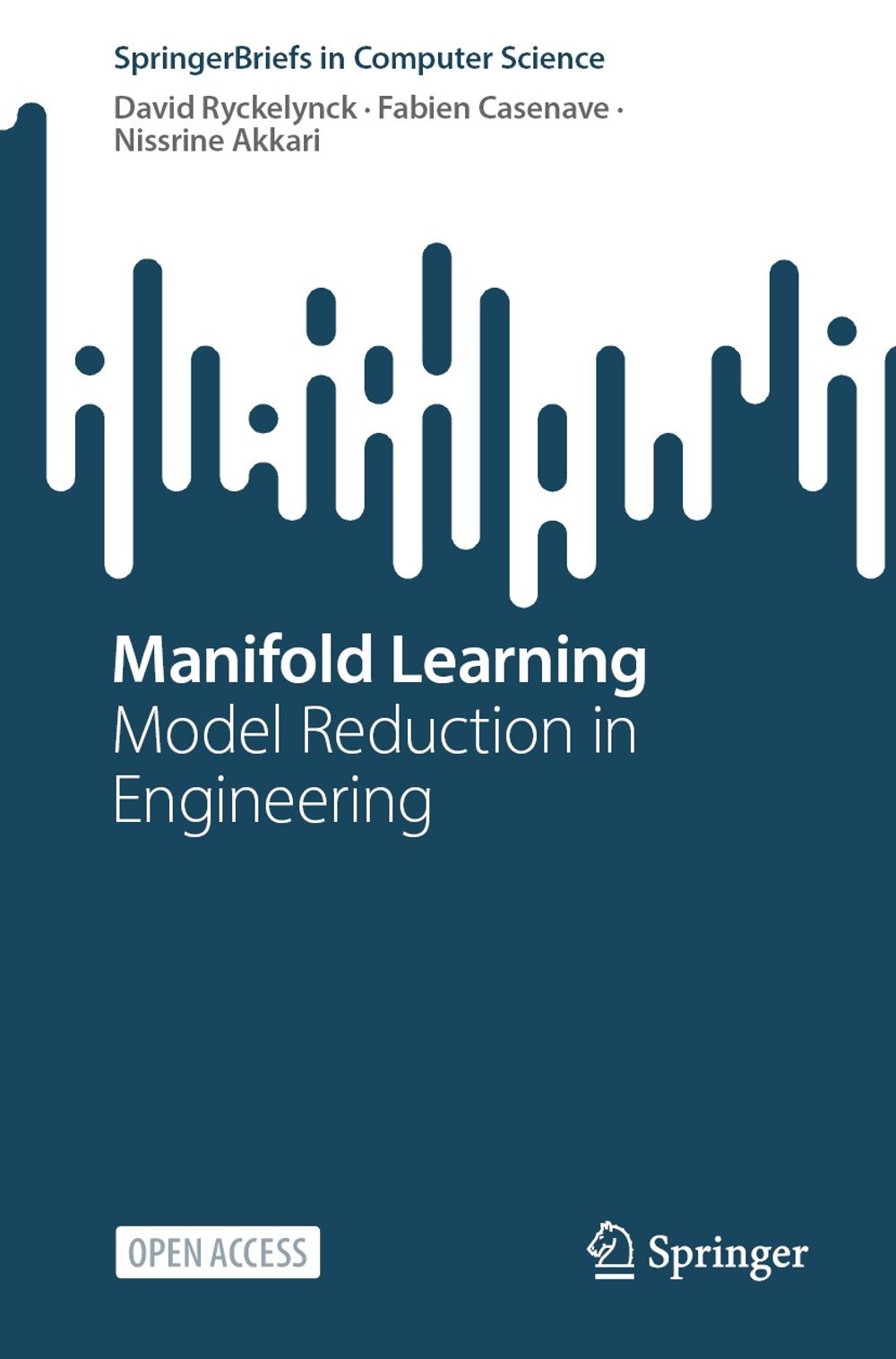



This Open Access book reviews recent theoretical and numerical developments in nonlinear model order reduction in continuum mechanics, being addressed to Master and PhD students, as well as to researchers, lecturers and instructors. The aim of the authors is to provide tools for a better understanding and implement reduced order models by using: physics-based models, synthetic data forecast by these models, experimental data and deep learning algorithms. The book involves a survey of key methods of model order reduction applied to model-based engineering and digital twining, by learning linear or nonlinear latent spaces. Projection-based reduced order models are the projection of mechanical equations on a latent space that have been learnt from both synthetic data and experimental data. Various descriptions and representations of structured data for model reduction are presented in the applications and survey chapters. Image-based digital twins are developed in a reduced setting. Reduced order models of as-manufactured components predict the mechanical effects of shape variations. A similar workflow is extended to multiphysics or coupled problems, with high dimensional input fields. Practical techniques are proposed for data augmentation and also for hyper-reduction, which is a key point to speed up projection-based model order reduction of finite element models. The book gives access to python libraries available on gitlab.com, which have been developed as part of the research program [FUI-25] MORDICUS funded by the French government. Similarly to deep learning for computer vision, deep learning for model order reduction circumvents the need to design parametric problems prior reducing models. Such an approach is highly relevant for image-base modelling or multiphysics modelling.
-
Autore:
-
Anno edizione:2024
-
Editore:
-
Formato:
-
Lingua:Inglese
Compatibilità:
Tutti i dispositivi (eccetto Kindle) Scopri di più
Layout:
Reflowable
EAN:
9783031527647

Formato:
Gli eBook venduti da Feltrinelli.it sono in formato ePub e possono essere protetti da Adobe DRM. In caso di download di un file protetto da DRM si otterrà un file in formato .acs, (Adobe Content Server Message), che dovrà essere aperto tramite Adobe Digital Editions e autorizzato tramite un account Adobe, prima di poter essere letto su pc o trasferito su dispositivi compatibili.
Cloud:
Gli eBook venduti da Feltrinelli.it sono sincronizzati automaticamente su tutti i client di lettura Kobo successivamente all’acquisto. Grazie al Cloud Kobo i progressi di lettura, le note, le evidenziazioni vengono salvati e sincronizzati automaticamente su tutti i dispositivi e le APP di lettura Kobo utilizzati per la lettura.
Clicca qui per sapere come scaricare gli ebook utilizzando un pc con sistema operativo Windows
