










LIBRO INGLESE





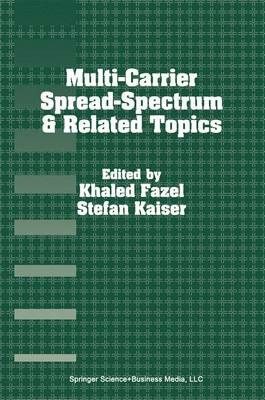
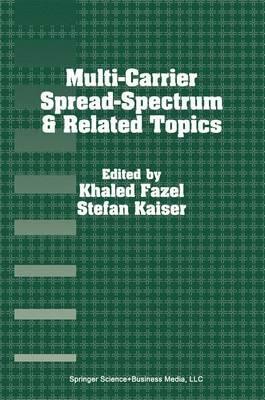
Multi-Carrier Spread-Spectrum & Related Topics: Third International Workshop, September 26–28, 2001, Oberpfafenhofen, Germany


131,60 €
+1320
punti 
Venditore: Feltrinelli
Articolo acquistabile con Carta del Docente

Articolo acquistabile con Carta Cultura Giovani e Carta del Merito

Articolo acquistabile con Carta della Cultura

Paga con Klarna in 3 rate senza interessi per ordini superiori a 39 €

Dati e Statistiche
 Salvato in 0 liste dei desideri
Salvato in 0 liste dei desideri
Multi-Carrier Spread-Spectrum & Related Topics: Third International Workshop, September 26–28, 2001, Oberpfafenhofen, Germany
Disponibilità in 2 settimane
131,60 €
131,60 €
Disponibilità in 2 settimane


Stefan Kaiser Khaled Fazel Radio System Design German Aerospace Center (DLR) Marconi Communications lnstitute of Communications and Navigation D-71522 Backnang, Germany D-82234 Wessling, Germany We are currently observing that frequency spectrum is a limited and valuable resource for wireless mobile communications. A good example can be observed among European network operators for the prices to pay for frequency bands for UMTS/IMT2000. Keeping this in mind, the fIrst goal when designing future wireless communication systems has to be the increase in spectral effIciency by allowing higher flexibility for the system design and deployment. The development in digital communications in the past years has enabled effIcient modulation and coding techniques for robust and spectral effIcient data, speech, audio and video transmission. Here, we should mention two interesting and successful techniques. These are the multi-carrier modulation (e. g. OFDM) and the spread spectrum technique (e. g. DS-CDMA). During the last decade of this millennium the technique of multi-carrier transmission for wireless broadband multimedia applications has received wide interest. Its fIrst great success was in 1990 as it was selected for the European Digital Audio Broadcasting (DAB) standard. Its further prominent success was in 1995 and 1998 as it was selected as modulation scheme for the European Digital Video Broadcasting (DVB-T) standard and in three broadband wireless indoor standards, namely European ETSI-HIPERLAN/2, American IEEE-802. 11a and Japanese MMAC, respectively.
-
Curatore:
-
Editore:
-
Anno:2002
-
Rilegatura:Hardback
Pagine:
376 p.
Testo in English
Dimensioni:
235 x 155 mm
EAN:
9780792376538

Informazioni e Contatti sulla Sicurezza dei Prodotti
Le schede prodotto sono aggiornate in conformità al Regolamento UE 988/2023. Laddove ci fossero taluni dati non disponibili per ragioni indipendenti da Feltrinelli, vi informiamo che stiamo compiendo ogni ragionevole sforzo per inserirli. Vi invitiamo a controllare periodicamente il sito www.lafeltrinelli.it per eventuali novità e aggiornamenti.
Per le vendite di prodotti da terze parti, ciascun venditore si assume la piena e diretta responsabilità per la commercializzazione del prodotto e per la sua conformità al Regolamento UE 988/2023, nonché alle normative nazionali ed europee vigenti.
Per informazioni sulla sicurezza dei prodotti, contattare productsafety@feltrinelli.it
