










EBOOK IN LINGUA STRANIERA





Neptune: Found by Mathematicians

2,99 €
+30
punti 
Venditore: Feltrinelli

Acquista online
Scaricabile subito
Articolo acquistabile con Carta del Docente

Articolo acquistabile con Carta Cultura Giovani e Carta del Merito

Articolo acquistabile con Carta della Cultura

Abbonati a Kobo plus per avere accesso illimitato a questo contenuto

Dati e Statistiche
 Salvato in 0 liste dei desideri
Salvato in 0 liste dei desideri
Neptune: Found by Mathematicians
Scaricabile subito
2,99 €
2,99 €
Scaricabile subito

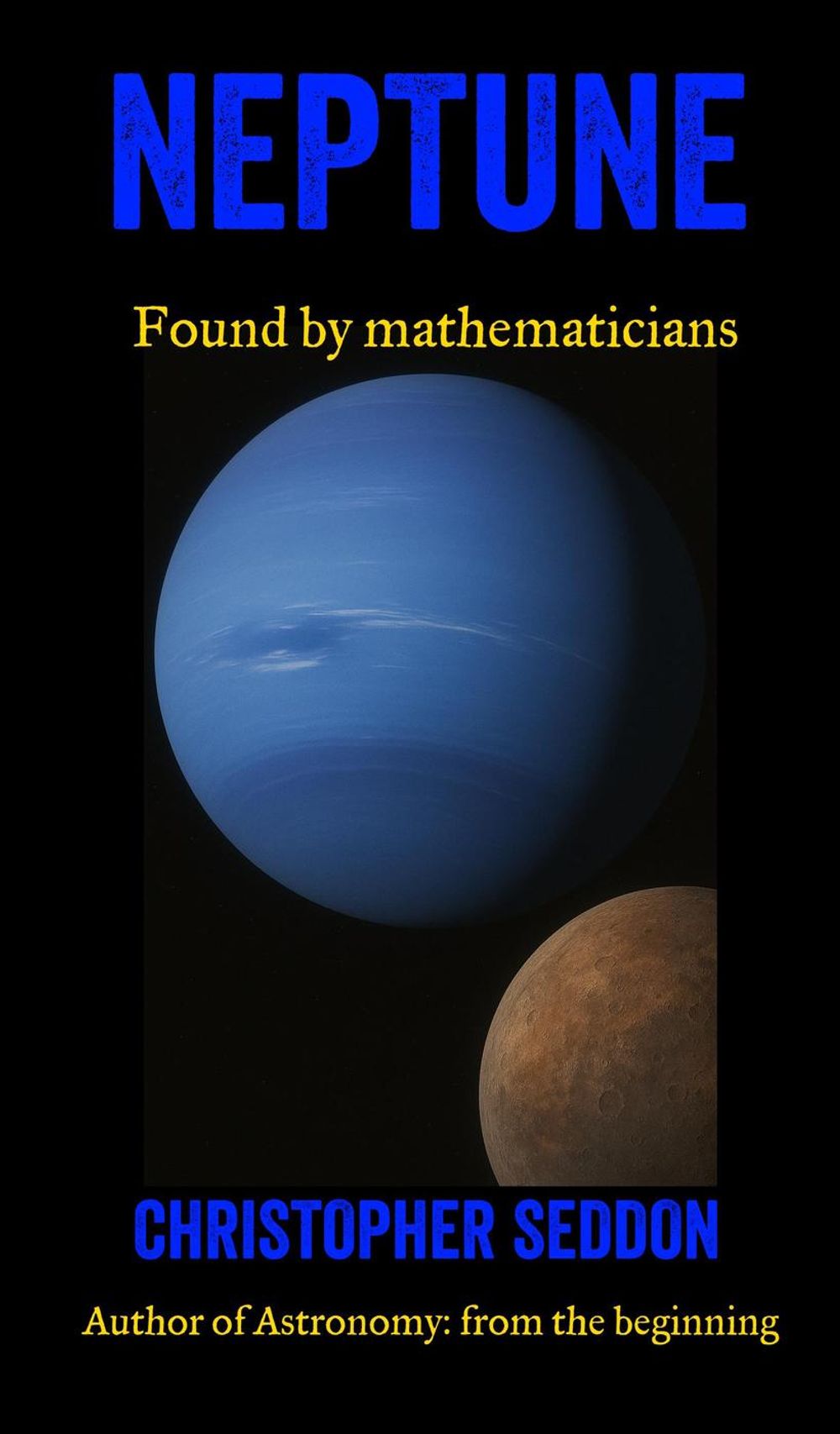



This 12,000 work eBook short read tells the story of Neptune's discovery and what we have learned in the 180 years since then. Neptune was discovered in 1846 after two mathematicians - John Couch Adams and Urbain Le Verrier - independently predicted that only the existence of an undiscovered planet beyond the orbit of Uranus could explain the latter's puzzling behaviour. Following Pluto's demotion, this distant planet has regained its place as the Solar System's outermost planet; a world so remote that despite being many times larger than Earth, it can never be seen with the naked eye. Although Neptune is a near-twin of Uranus, it is not an identical twin. It is larger, less dense, and lacks Uranus's extreme axial tilt. Despite its serene appearance, it hosts some of the most violent weather in the Solar System, with windspeeds of up to 900 miles per hour. Neptune also hosts the Solar System's largest retrograde moon - Triton, captured from the distant Kuiper belt, is only slightly smaller than our own Moon. Despite this, its retrograde orbit means that it is slowly spiralling to destruction. Element 94, produced in the laboratory a few months later, was given the name plutonium after Pluto. Neither neptunium nor plutonium exists in nature. Neptune has 14 known moons, far fewer than Jupiter or Saturn, or even Uranus. However, unlike the latter, Neptune has one large moon, Triton. The Solar System's seventh-largest moon, Triton is midway in size between the Moon and Pluto. Although it is not uncommon for moons to orbit their primaries in a retrograde orbit, Triton is the only large moon in the Solar System to do so. The Saturnian moon Phoebe, with a diameter one-eighth that of Triton, is the largest-known retrograde moon, and most are far smaller. Triton's retrograde orbit means that it is gradually spiralling in towards Neptune. It is already closer to Neptune than the Moon is to Earth and eventually, it will enter Roche limit and be pulled apart by tidal forces. The result will be a ring system many times brighter than the one Saturn currently has. However, this will not happen for around 3.6 billion years. To date, Neptune has been visited by just one space probe, Voyager 2, in 1989. There have been various proposals for further missions to Neptune, though none have reached the development stage. Trident was a proposed NASA Discovery-class mission, which would have involved a flyby of Neptune and Triton. The relatively low-cost mission would have launched in 2025 and reached the Neptune system in 2038 after a Jupiter gravity assist. But it was passed over in favour of a pair of probes to be sent to Venus. Even if they do eventually fly, spacecraft currently being considered by NASA and the Chinese National Space Administration are unlikely to reach Neptune until around the mid-century. Since its discovery in 1846, Neptune has completed just over one circuit of the Sun. It completed its first orbit since discovery at 22:27 GMT on 12 July 2011. The second will not be completed until 2176.
-
Autore:
-
Anno edizione:2026
-
Editore:
-
Formato:
-
Lingua:Inglese
Compatibilità:
Tutti i dispositivi (eccetto Kindle) Scopri di più
Layout:
Reflowable
EAN:
9781916296497

Formato:
Gli eBook venduti da Feltrinelli.it sono in formato ePub e possono essere protetti da Adobe DRM. In caso di download di un file protetto da DRM si otterrà un file in formato .acs, (Adobe Content Server Message), che dovrà essere aperto tramite Adobe Digital Editions e autorizzato tramite un account Adobe, prima di poter essere letto su pc o trasferito su dispositivi compatibili.
Cloud:
Gli eBook venduti da Feltrinelli.it sono sincronizzati automaticamente su tutti i client di lettura Kobo successivamente all’acquisto. Grazie al Cloud Kobo i progressi di lettura, le note, le evidenziazioni vengono salvati e sincronizzati automaticamente su tutti i dispositivi e le APP di lettura Kobo utilizzati per la lettura.
Clicca qui per sapere come scaricare gli ebook utilizzando un pc con sistema operativo Windows
