










LIBRO INGLESE





System-2 Reasoning: from Semantic Anchoring to Causal Intelligence, Volume 2: The Path to Artificial General Intelligence

96,80 €
+970
punti 
Prezzo minimo ultimi 30 giorni: 87,14 €
Venditore: Feltrinelli
Articolo acquistabile con Carta del Docente

Articolo acquistabile con Carta Cultura Giovani e Carta del Merito

Articolo acquistabile con Carta della Cultura

Paga con Klarna in 3 rate senza interessi per ordini superiori a 39 €

Dati e Statistiche
 Salvato in 0 liste dei desideri
Salvato in 0 liste dei desideri
System-2 Reasoning: from Semantic Anchoring to Causal Intelligence, Volume 2: The Path to Artificial General Intelligence
Disponibilità in 3 settimane
96,80 €
96,80 €
Disponibilità in 3 settimane

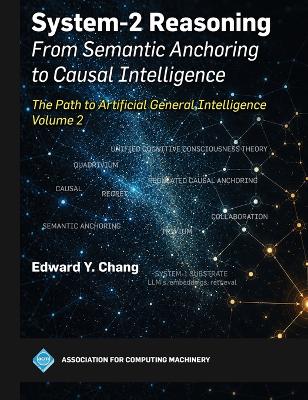


Large language models can write poetry, pass bar exams, and generate fluent code. Yet they continue to fail in the domains where intelligence must be accountable: distinguishing causation from correlation, recognizing when evidence is insufficient, preserving commitments over time,and correcting their own reasoning failures. This book argues that the transition from pattern matching to genuine reasoning requires a System-2 layer grounded in coordinated diagnosis, audit, causal validation, memory, and meta-cognitive control. The volume develops this architecture from first principles through operational protocols. Semantic Anchoring (UCCT) demonstrates how contextual constraints can bind latent model representations into governed reasoning processes rather than prior-driven completion. Regulated Causal Anchoring (RCA) and RAudit diagnose sycophancy, pathological skepticism, and trace-output inconsistency without relying exclusively on ground-truth supervision. The Causal Abstraction Bridge and the CausalTSK benchmark reveal where models collapse from interventional and counterfactual reasoning back into associative prediction. Epistemic Regret Minimization (ERM) identifies causal shortcuts and failures of warranted inference, while Reinforcement Learning from Epistemic Regret (RLER) transforms those reasoning failures into a structured learning signal. Trivium introduces temporal accountability through a Causal Transaction Log, and Quadrivium integrates contextual, causal, temporal, and meta-cognitive regulation into a unified System-2 MACI architecture. The author's central thesis is that Artificial General Intelligence (AGI) will not emerge from scaling monolithic pattern-completion systems alone. AGI will require architectures capable of explaining why an answer is warranted, refusing conclusions when evidence remains indeterminate, and improving through epistemic failure. Written for researchers, advanced students, and practitioners, this book presents a framework for AI systems that are not merely impressive, but auditable, corrigible, and trustworthy. It is suitable for graduate-level courses in artificial intelligence, multi-agent systems, causal reasoning, and trustworthy AI.
-
Autore:
-
Editore:
-
Collana:ACM Books
-
Anno:2026
Rilegatura:
Hardback
Testo in English
EAN:
9798400728044

Informazioni e Contatti sulla Sicurezza dei Prodotti
Le schede prodotto sono aggiornate in conformità al Regolamento UE 988/2023. Laddove ci fossero taluni dati non disponibili per ragioni indipendenti da Feltrinelli, vi informiamo che stiamo compiendo ogni ragionevole sforzo per inserirli. Vi invitiamo a controllare periodicamente il sito www.lafeltrinelli.it per eventuali novità e aggiornamenti.
Per le vendite di prodotti da terze parti, ciascun venditore si assume la piena e diretta responsabilità per la commercializzazione del prodotto e per la sua conformità al Regolamento UE 988/2023, nonché alle normative nazionali ed europee vigenti.
Per informazioni sulla sicurezza dei prodotti, contattare productsafety@feltrinelli.it
