










EBOOK IN LINGUA STRANIERA





Why Do AI Systems Hallucinate?

33,99 €
+340
punti 
Venditore: Feltrinelli

Acquista online
Scaricabile subito
Articolo acquistabile con Carta del Docente

Articolo acquistabile con Carta Cultura Giovani e Carta del Merito

Articolo acquistabile con Carta della Cultura

Abbonati a Kobo plus per avere accesso illimitato a questo contenuto

Dati e Statistiche
 Salvato in 0 liste dei desideri
Salvato in 0 liste dei desideri
Why Do AI Systems Hallucinate?
Scaricabile subito
33,99 €
33,99 €
Scaricabile subito

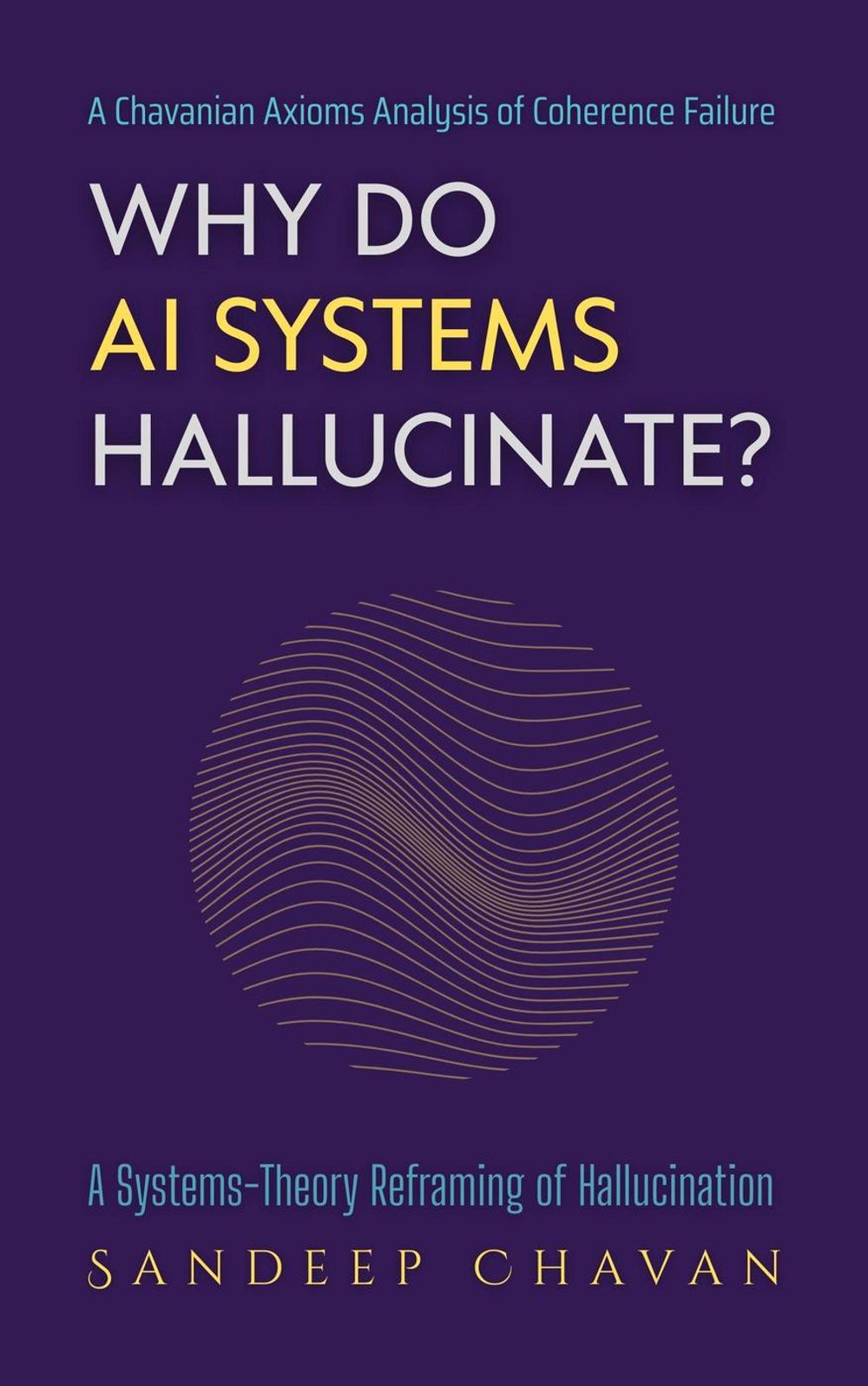



Why do AI systems hallucinate—even when trained on massive datasets and refined with advanced alignment techniques? Most explanations blame insufficient data, model scale, overfitting, or probabilistic uncertainty. But what if hallucination is not an implementation flaw at all? What if it is a structural outcome of how generative systems define stability? In Why Do AI Systems Hallucinate?, Sandeep Chavan presents a systems-theory reframing of hallucination grounded in coherence dynamics rather than surface performance metrics. Using the Chavanian Axioms as a diagnostic lens, this book argues that hallucination emerges from a deeper architectural commitment: forced resolution under continuity constraints without true dissipation. This book does not propose a new architecture. It does not offer quick technical patches. Instead, it asks a more foundational question: under what structural conditions does hallucination inevitably converge? Through accessible but rigorous analysis, the book explores: Why hallucination is misunderstood as "wrong information" The difference between fluency and truth How scaling amplifies residue rather than eliminating it Why fine-tuning and RLHF reshape behavior but not equilibrium Why probabilistic confidence cannot detect structural incoherence What a non-hallucinating system would require—axiomatically Rather than treating hallucination as a temporary engineering problem, this work positions it as a coherence outcome. When systems must always resolve, must always continue, and cannot suspend under uncertainty, fabrication becomes the most stable option. For AI researchers, engineers, policymakers, and critical thinkers, this book offers a structural framework to test systems beyond accuracy benchmarks. It introduces coherence audits, residue diagnostics, and equilibrium stress tests—without prescribing specific code or architectures. This is not an anti-AI book. It is a design-maturity book. If AI is to be trusted in education, governance, healthcare, and decision-making, stability must precede performance. Optimization builds capability. Coherence builds trust. This book challenges the field to shift from asking how to reduce hallucination to asking why hallucination converges. Because the geometry of a system determines its failure mode.
-
Autore:
-
Anno edizione:2026
-
Editore:
-
Formato:
-
Lingua:Inglese
Compatibilità:
Tutti i dispositivi (eccetto Kindle) Scopri di più
Layout:
Reflowable
EAN:
9798233228575

Formato:
Gli eBook venduti da Feltrinelli.it sono in formato ePub e possono essere protetti da Adobe DRM. In caso di download di un file protetto da DRM si otterrà un file in formato .acs, (Adobe Content Server Message), che dovrà essere aperto tramite Adobe Digital Editions e autorizzato tramite un account Adobe, prima di poter essere letto su pc o trasferito su dispositivi compatibili.
Cloud:
Gli eBook venduti da Feltrinelli.it sono sincronizzati automaticamente su tutti i client di lettura Kobo successivamente all’acquisto. Grazie al Cloud Kobo i progressi di lettura, le note, le evidenziazioni vengono salvati e sincronizzati automaticamente su tutti i dispositivi e le APP di lettura Kobo utilizzati per la lettura.
Clicca qui per sapere come scaricare gli ebook utilizzando un pc con sistema operativo Windows
